Chapter 13
Traditions, beliefs and stances
Your tradition decides what the building needs, who approves your projects, how your clergy come, what you owe the wider church and what it can do to you, how your people belong and give, and what your church will and won't do. Forty ship: thirty-nine specific bodies (the Assemblies of God, not "Pentecostal"), five of them networks of independent churches, plus the pattern many independent churches share. This chapter gives each a short practical profile, then covers the denomination and everything it does, changing practice, stances, leaving, and founding a tradition of your own.
Every tradition is a draft awaiting review by someone from that tradition, and some numbers (what's owed upward, especially) are estimates. They describe how each body's churches commonly work, not every congregation in it.
Choosing a tradition
The sandbox lists the traditions by name; this chapter groups them by family. A tradition belongs to one family or two (the Free Methodists are holiness and Methodist; Acts 29 is independent and Reformed), and in play a family counts for little: it's the smallest part of how alike two traditions are, which decides how readily newcomers from another church settle in (see Belonging and giving). Some bodies are really two or more kinds of congregation, and have variants you choose when you found the church: traditional or contemporary United Methodists and Nazarenes, white or Black American Baptist churches, the Moravians' Northern or Southern Province, a Salvation Army corps with a brass band or a praise band, an IPHC church of transfer members, a Unitarian Universalist congregation or a lay-led fellowship, a Christian church with traditional or contemporary worship, a Vineyard church or a Spanish-speaking La Viña, an Acts 29 church that baptizes believers or one that baptizes infants, and a Baptistic, charismatic, or Reformed-leaning nondenominational church. A scenario picks one for you.
The traditions at a glance
Who decides each kind of project in each tradition is in Projects, approvals and conflict; how clergy come is in Staff and volunteers.
| Tradition | Main worship | Communion a year | Leader | Owes upward |
|---|---|---|---|---|
| Catholic and Orthodox | ||||
| Catholic Church | Mass, Saturday evening and Sunday | 52 | Priest, sent | 10% of income |
| Ukrainian Greek Catholic | Divine Liturgy, in Ukrainian and English | 52 | Priest, sent; may be married | 8%, and a voluntary collection |
| Orthodox Church in America | Divine Liturgy and Saturday Vigil | 52 | Priest, sent | $90 a member |
| Coptic Orthodox | Coptic Liturgy, two Sunday liturgies | 52 | Priest ordained from the parish, for life | 10% |
| Anglican and Lutheran | ||||
| The Episcopal Church | Holy Eucharist at 8 and 10 | 52 | Rector, called by the vestry | 12% |
| ELCA | Divine Service | 52 | Pastor, called from the synod's list | 7%, voluntary |
| Missouri Synod | Divine Service | 26 | Pastor, called on a nomination | 6%, voluntary |
| Reformed and united | ||||
| Presbyterian Church (U.S.A.) | Word and Table | 12 | Pastor, called from the presbytery's list | Per capita and mission giving, voluntary |
| Christian Reformed | Reformed worship, morning and evening | 4 | Pastor, called from the classis's list | Classis quota and pension, per member; ministry shares voluntary |
| United Church of Christ | Word and Table | 12 | Pastor, called | 2%, voluntary |
| Methodist and holiness | ||||
| The United Methodist Church | Preaching service (or contemporary) | 12 | Pastor, appointed and moved | 12% |
| AME | Black-church worship | 12 | Pastor, appointed and moved | 8% and $25 a member |
| Free Methodist | Preaching service | 12 | Pastor, appointed | $180 a member |
| Church of the Nazarene | Preaching service (or contemporary) | 4 | Pastor, called by two thirds | 15% in four funds |
| The Salvation Army | Holiness meeting | none | Officers, a couple, sent | Offerings go up; a budget comes down |
| Baptist | ||||
| Southern Baptist | Preaching service | 4 | Pastor, called | 4.67%, voluntary |
| American Baptist | Preaching service | 12 | Pastor, called | 4%, voluntary |
| National Baptist | Black-church worship | 12 | Pastor, called | $1,200 a year, voluntary |
| Pentecostal | ||||
| Assemblies of God | Praise and worship | 12 | Pastor, called by two thirds | 3%, voluntary; the pastor's dues |
| Church of God (Cleveland) | Praise and worship | 4 | Pastor, appointed | 14% of tithes; the pastor's tithe |
| Church of God in Christ | Black-church worship | 12 | Pastor, appointed for life | Reports of $4,200 a year |
| Pentecostal Holiness | Praise and worship | 4 | Pastor, nominated and ratified | 10% of tithes; the pastor's tithe |
| United Pentecostal | Praise and worship, morning and evening | 2 | Pastor, called, for life | A voluntary goal; the pastor's dues |
| Anabaptist, Moravian, and Friends | ||||
| Mennonite Church USA | Preaching service | 4 | Pastor, called | 4%, voluntary |
| Church of the Brethren | Preaching service | 2, at the love feast | Pastor, called | 4%, voluntary |
| Moravian Church | Moravian liturgy | 7 | Pastor, called by the province | 8% |
| Friends (FGC) | Meeting for worship, in silence | none | None: a clerk | $60 a member, voluntary |
| Friends United Meeting | Pastoral meeting for worship | none | Pastor, who doesn't govern | 8% |
| Restorationist | ||||
| Churches of Christ | Lord's Day assembly, a cappella | 52 | Elders and a minister | Nothing |
| Christian Churches and Churches of Christ | Worship around the Lord's table | 52 | Minister, called by the elders | Nothing |
| Independent churches and networks | ||||
| Nondenominational (pattern) | Praise and worship, two services | 12 | Lead pastor, called by the elders | Nothing |
| Calvary Chapel | Worship and teaching, Sunday and Wednesday | 12 | Senior pastor, called by the board | Nothing |
| Acts 29 | Preaching service | 52 | Lead pastor and elders, called by the elders and members | 2%; 8% to planting, voluntary |
| Charismatic | ||||
| Vineyard USA | Praise and worship, then ministry time | 12 | Lead pastor, called by the church board | 3% |
| Association of Related Churches | Praise and worship, two services | 12 | Lead pastor and spouse, called by the elders | 10% while launching, then 2%, voluntary |
| Distinct traditions | ||||
| Seventh-day Adventist | Sabbath School and divine worship, Saturday | 4 | Pastor, appointed | 15% tithe |
| Latter-day Saints | Sacrament meeting | 52 | Lay bishop, called for five years | Offerings go up; a budget comes down |
| Jehovah's Witnesses | Weekend and midweek meetings | 1, the Memorial | Body of elders, unpaid | 25%, voluntary |
| Christian Science | Lesson-Sermon, and Wednesday testimony | none | Two Readers, elected | $1 a member, paid by members |
| Unitarian Universalist | Chalice service | none | Minister, called by 90% | 6.75%, voluntary |
Catholic and Orthodox
Catholic Church
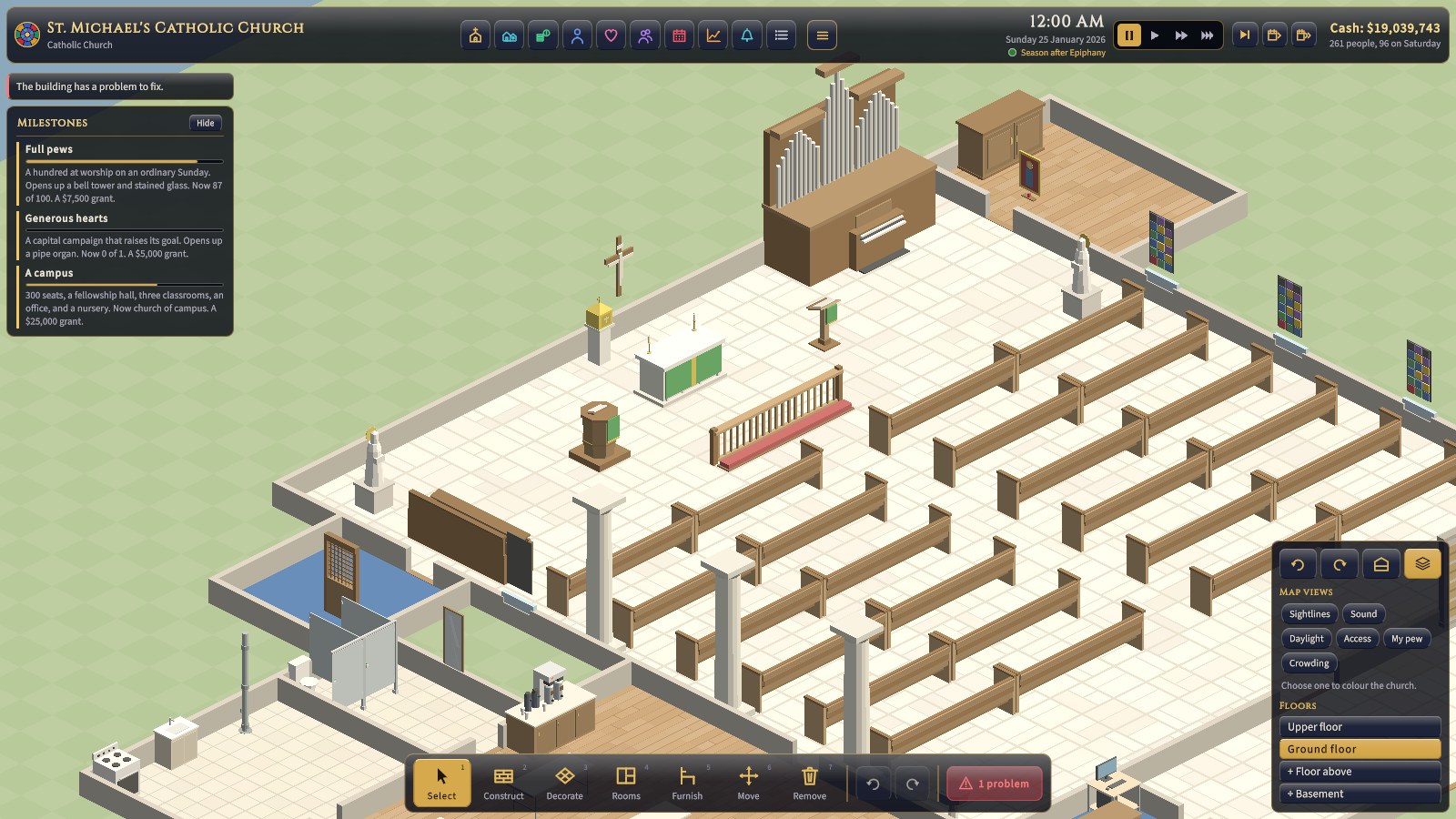
A parish of the Latin Rite: Mass on Saturday evening and Sunday morning (an 8 o'clock and a Spanish Mass if you want them), the full church year with the Fridays of Lent kept, weekly communion received at stations, and seven sacraments, confirmation by the bishop among them.
- Required: Altar, Baptismal font, Tabernacle, a sacristy.
- Expected: an organ (pipe or electronic), statues, a Crucifix, a Lectern, a reconciliation room.
- Fits best: almost every formal item scores +1: altar, rail, font, tabernacle, organs, statues, crucifix, stained glass, pillars, paraments, the steeple. Chairs and the projection screen score −1, drums and the sound system −0.5.
The diocese sends your priest, for six-year terms; priests are scarce and celibate, and a parish under 60 at Mass shares one. Parishioners don't vote: the priest decides renovations with the finance council's advice (a week), and the diocese decides new building, wanting the parish solvent and in good standing, so pay the 10% assessment. Changes made on authority provoke harsher reactions (see Projects, approvals and conflict). Fundraising is open (bingo, the Lenten fish fry, the parish festival), Mass stipends add a little, and a parish school is offered, a fifth of its cost paid by the diocese. Gothic suits a Catholic church almost perfectly. A parish can't vote to leave.
Ukrainian Greek Catholic Church
The Byzantine liturgy in communion with Rome: the Divine Liturgy on Sunday in Ukrainian and in English behind an iconostasis, infants baptized by immersion and given communion, the Byzantine Catholic year with lighter fasts than the Orthodox, and the Great Blessing of Waters and the Easter basket blessing.
- Required: Altar, Iconostasis, Immersion font, Tabernacle, a sacristy.
- Expected: icons, Choir stalls, a Chanter's stand, a Lectern, a reconciliation room, a fellowship hall and kitchen, and the church facing east. Pews, organs, pianos, drums, and statues are discouraged.
The eparchy sends the priest, who may be married; priests are scarce and shared below 60. The eparchial assessment is 8%, and the Collection for Ukraine a voluntary $1,500 a year. Candles and stipends bring in a little at every Liturgy, fundraising is open, and the Sisterhood forms as the parish grows. It can't vote to leave.
Orthodox Church in America
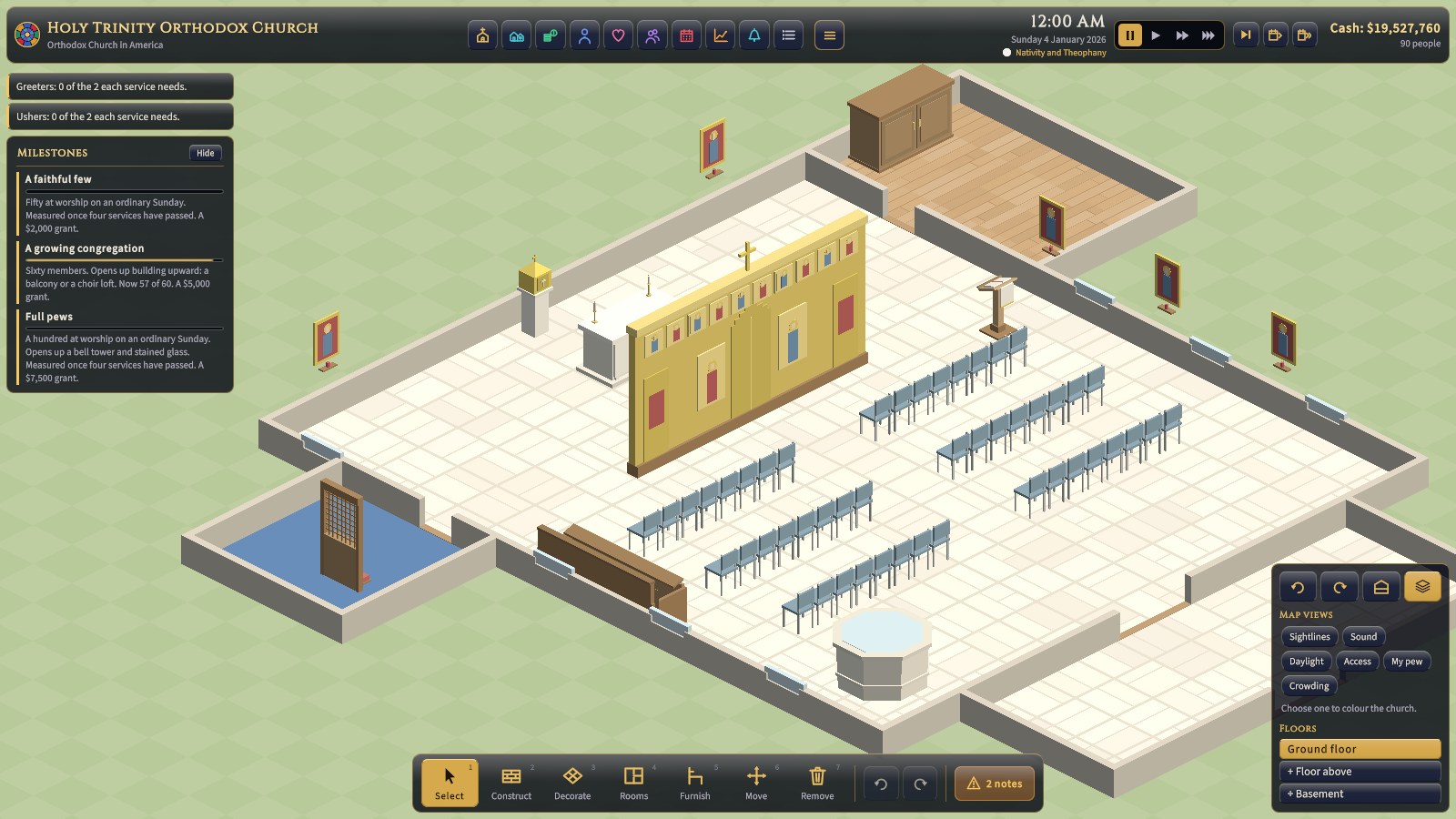
The Divine Liturgy on Sunday and the Vigil on Saturday evening, sung throughout without instruments; the iconostasis between nave and sanctuary; infants baptized by triple immersion, chrismated, and communed by spoon; the Eastern church year, with strict fasts.
- Required: Altar, Iconostasis, Immersion font, Tabernacle, a sacristy.
- Expected: icons, Choir stalls, a Chanter's stand, a Lectern, a Three-bar cross, a reconciliation room, and the church facing east.
- Forbidden: organs, pianos, the Hammond organ, drums, brass, and handbells: each is an error in the building check. Discouraged: Oak pew, statues.
- Fits best: icons, the iconostasis, choir stalls, the chanter's stand, and every formal item (+1). Chairs, instruments, and statues −1.
The faithful traditionally stand. Pews are discouraged (−0.03), but standing costs far more (−0.15), and chairs score −1 for fit: a few rows of chairs in a nave full of icons and formal furniture is the best compromise. Turn the lot in Church → Church so the church faces east. The diocese sends a priest (married before ordination, or not), from a scarce supply. The assessment is $90 a member, and falling behind on it costs the parish its voice: the diocese turns down its projects and sends it the weakest priest. In a strict fast, church meals cost more and fewer stay, and weddings aren't held. Candles and open fundraising help.
Coptic Orthodox Church
The Coptic Liturgy, two to three hours, at 7 (in Arabic) and 9:30 on Sunday, with Friday and Saturday liturgies; chanted throughout, with men and women seated apart; the haikal screen before the sanctuary; infants baptized by triple immersion; the Coptic year, with some 210 strict fast days.
- Required: Altar, Haikal screen, Immersion font, a sacristy.
- Expected: icons, a Coptic cross, a Chanter's stand, a Lectern, a reconciliation room, the church facing east.
- Forbidden: organs, the Hammond organ, brass, handbells, statues. Discouraged: piano, drums, a crucifix.
The parish names its priest from its own members (Ask who'd serve), married before ordination, and the diocese ordains him, for life. Members don't vote; the priest decides renovations at once. The diocesan contribution is 10%. Giving is by contribution boxes and the plate; candles help. The fasts make meals dear and weddings rare for much of the year. It can't vote to leave.
Anglican and Lutheran
The Episcopal Church
The Holy Eucharist at 8 and 10 on Sunday, with the full church year and the Fridays of Lent; weekly communion at the rail from a common cup; infant baptism; the reserved sacrament.
- Required: Altar, Communion rail, Baptismal font, Tabernacle, a sacristy.
- Expected: an organ, Choir stalls, a cross, a Lectern.
The vestry decides renovations, and calls a rector with the bishop's consent; an interim serves through the search. The diocesan assessment (12%) is required, and falling behind on it costs the parish its voice. A parish that shrinks below 15 members for a year, or falls to 25% regard for six months, is reduced to a mission, whose vicar the bishop appoints; it can vote to be a parish again at 40 members, paying its way. Leaving takes two thirds and the diocese's consent, and the building stays behind: the settlement is its whole worth.
Evangelical Lutheran Church in America
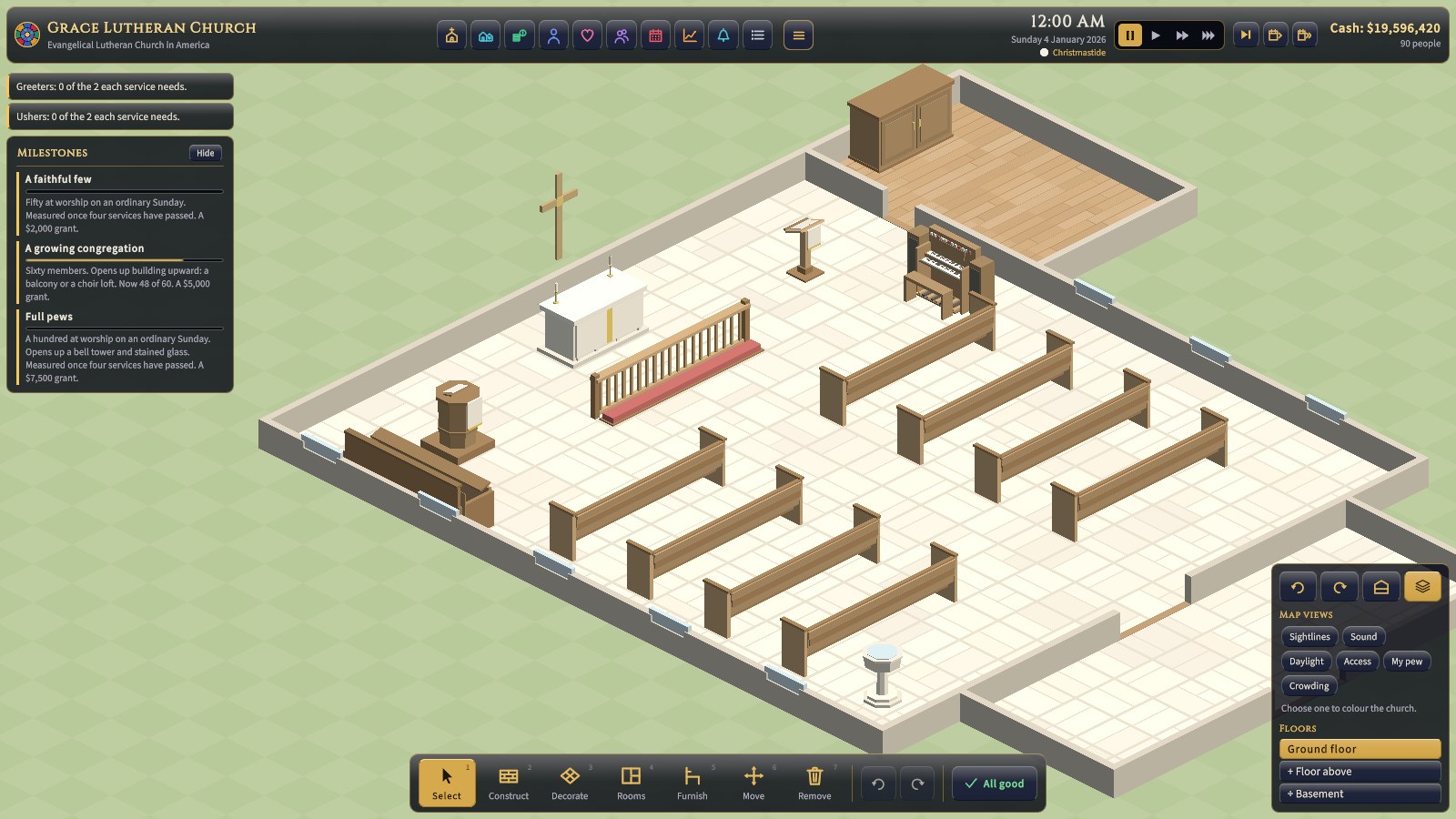
Word and sacrament in balance: a pulpit beside the altar, weekly communion at the rail, infant baptism, and a strong tradition of organ and choir.
- Required: Altar, Pulpit, Baptismal font, Communion rail, a sacristy.
- Expected: an organ, Choir stalls, a cross, a Lectern.
- Fits best: the electronic organ and a cross (+1), choir stalls and the pipe organ (+0.67), formal items (+0.33). Chairs and the projection screen −0.33.
The congregation council votes on renovations; the members on new building. A pastor comes from the synod's list (two candidates, a little more skilled), called by two thirds of the members with the synod's consent, with an interim between. Mission support (7%) is voluntary. The congregation decides whether it's affirming, and can become Reconciling in Christ. Lutherans want the most reverberant room of any tradition, so stone floors and Gothic walls pay off. Leaving takes two votes, three months apart, each by two thirds, and the synod's consent.
The Lutheran Church—Missouri Synod
The Divine Service, highly formal, with communion every other Sunday for those of its own fellowship, individual confession if asked, and Wednesday services in Lent and Advent; a confessional church that worships only with its own.
- Required: Altar, Pulpit, Baptismal font, Communion rail, a sacristy.
- Expected: an organ, a Lectern, a fellowship hall and kitchen. Icons and the Hammond organ are discouraged.
The wider body puts forward one candidate at a time, whom the members call; an interim serves meanwhile, and a small church shares its pastor. The board of elders is men only, and the board of trustees decides renovations. District mission support (6%) is voluntary. A parish school is offered (with no help from the district). Lodges are forbidden on church property, and the church keeps out of politics. Its claim on a church's property wouldn't hold up, so leaving (two thirds) costs nothing.
Reformed and united
Presbyterian Church (U.S.A.)
Word and Table on Sunday, communion monthly with wine and juice both offered, infants baptized by sprinkling, and the full church year.
- Required: Communion table, Pulpit, Baptismal font, a sacristy.
- Expected: an organ, Choir stalls, a cross, Communion trays.
The trustees decide renovations; the members vote on new building and calls, each with the presbytery's consent. Pastors come from the presbytery's list, and a full-time one is never paid under $50,000. The per capita ($40 a member) and shared mission giving (3%) are voluntary. The church is affirming. Leaving is by gracious dismissal: a majority, the presbytery's consent, and half the building's worth.
Christian Reformed Church in North America
Two services every Sunday, catechism for the young, communion four times a year, infants baptized, banners rather than images, and officebearers who sign the confessions.
- Required: Communion table, Pulpit, Baptismal font, a sacristy.
- Expected: an organ, banners, Communion trays. Images of Christ are discouraged.
The council decides renovations, the members new building; calls go to the members with the classis's consent. Only confessing members of two years or more sit on the council, and under formal discipline those who've fallen away are taken off the rolls each January. The classis quota and pension assessment ($87.20 a member together) are required; ministry shares ($250 a member) are voluntary. Gambling and lodges are forbidden. The congregation decides whether women serve as officebearers and pastors. Many of its children go to the nearby Christian school. Leaving takes two votes a month apart and the classis's consent.
United Church of Christ
Word and Table with the lectionary, monthly communion open to all, church school during worship, no formal discipline, and congregations that govern themselves.
- Required: Communion table, Pulpit, Baptismal font, a sacristy.
- Expected: an organ, a cross, Communion trays.
The members decide everything, including calling a pastor (with an interim between). Basic Support (2%) is voluntary, fundraising is open, and renting space is something its churches are known for. The congregation decides whether it's affirming, and can vote to become Open and Affirming or a Just Peace church. Leaving costs nothing.
Methodist and holiness
The United Methodist Church
A preaching service with an organ and choir (a contemporary church has a praise service too), monthly communion at the rail by intinction, open to all, infants baptized, the full year, the love feast, covenant renewal, and Watch Night.
- Required: Altar, Communion rail, Baptismal font, Pulpit, a sacristy.
- Expected: an organ, Choir stalls, a cross, a Lectern, a fellowship hall and kitchen.
The bishop appoints the pastor, into a parsonage, and may move them each July at the yearly review; the staff-parish relations committee is consulted, so an unhappy church sees its pastor moved sooner. Turn moves off on the Staff screen to keep a good one. A full-time pastor is paid at least $48,000, and a church under 70 shares one. The trustees decide renovations, the district new building. Apportionments (12%) are required. The building is dry and gambling is forbidden. The congregation decides whether it's affirming, and can become a Reconciling Congregation. Leaving takes two thirds, the wider body's consent, and 30% of the building's worth.
African Methodist Episcopal Church
Long, responsive Black-church worship on Sunday at 11, a Wednesday prayer meeting, monthly communion at the rail, walked offerings, and Watch Night, Women's Day, and Homecoming.
- Required: Communion rail, Communion table, Baptismal font, Pulpit, a sacristy.
- Expected: a Hammond organ, a Upright piano, Choir stalls, a cross, a fellowship hall and kitchen.
The bishop appoints and moves the pastor, at the yearly review, into a parsonage. Pastors rise from licentiate through itinerant deacon to elder; until yours is an elder, an elder visits for each communion ($150). The trustees decide renovations, with a strong pastor's view swaying them. Three obligations stack: the General Budget ($25 a member; falling behind costs the church its voice), the conference claims (6%), and the district (2%). The wider body is present in everything: it visits four times a year, and its regard follows what you do quickly. Four auxiliaries, from the Stewardess Board to the Usher Board, and a First Lady, enrich the church's life.
Free Methodist Church USA
A preaching service with a band, monthly communion at the rail, infants baptized or dedicated, and covenant membership.
- Required: Communion rail, Communion table, Baptismal font, Pulpit.
- Expected: a Drum kit and Sound system.
The conference appoints the pastor, who stays as long as it suits. The Board of Administration (tithers) decides renovations, and the conference consents to new building. Conference support is $180 a member. Membership is a covenant, exclusive, under formal discipline; lodges, alcohol, tobacco, and gambling are forbidden. Consecrated deacons from the members widen the pastor's care, and the conference camp holds families.
Church of the Nazarene
A preaching service with a weekly altar call at the mercy seat, quarterly communion at the rail, infants baptized or dedicated as parents wish, and revivals and camp meetings.
- Required: Baptistry, Communion rail, Communion table, Pulpit.
- Expected: a Upright piano, a Mercy seat, Communion trays.
The members call a pastor by two thirds, with the district's consent. A church below 35 members, or at 30% regard, for six months has its pastor appointed instead; it can vote to call again at 35 members, paying its way. The church board decides renovations; the members vote on new building, with the district's consent. Four obligations (the World Evangelism Fund, the district, education, and pensions) come to 15% of income. Tithing is expected.
The Salvation Army
A corps, not a church: the holiness meeting on Sunday with brass and the mercy seat, no sacraments (soldiers are enrolled instead), the Army's flag, Founders' Day, the Self-Denial appeal, and the Red Kettle season.
- Required: Pulpit, a social-service office.
- Expected: brass band stands, the Army's flag, a Mercy seat, a fellowship hall and kitchen.
The division sends a married couple of officers for three-year terms, ranked lieutenant, captain, and major, and pays them itself. It funds the corps centrally: each month's offerings go up, and a budget of $25 for each active person, plus the building's costs, comes down. The division decides everything past routine spending. The corps runs social services, raises the Red Kettle appeal each December, and holds open-air meetings. Soldiers don't vote, and the corps can't vote to leave.
Baptist
Southern Baptist Convention
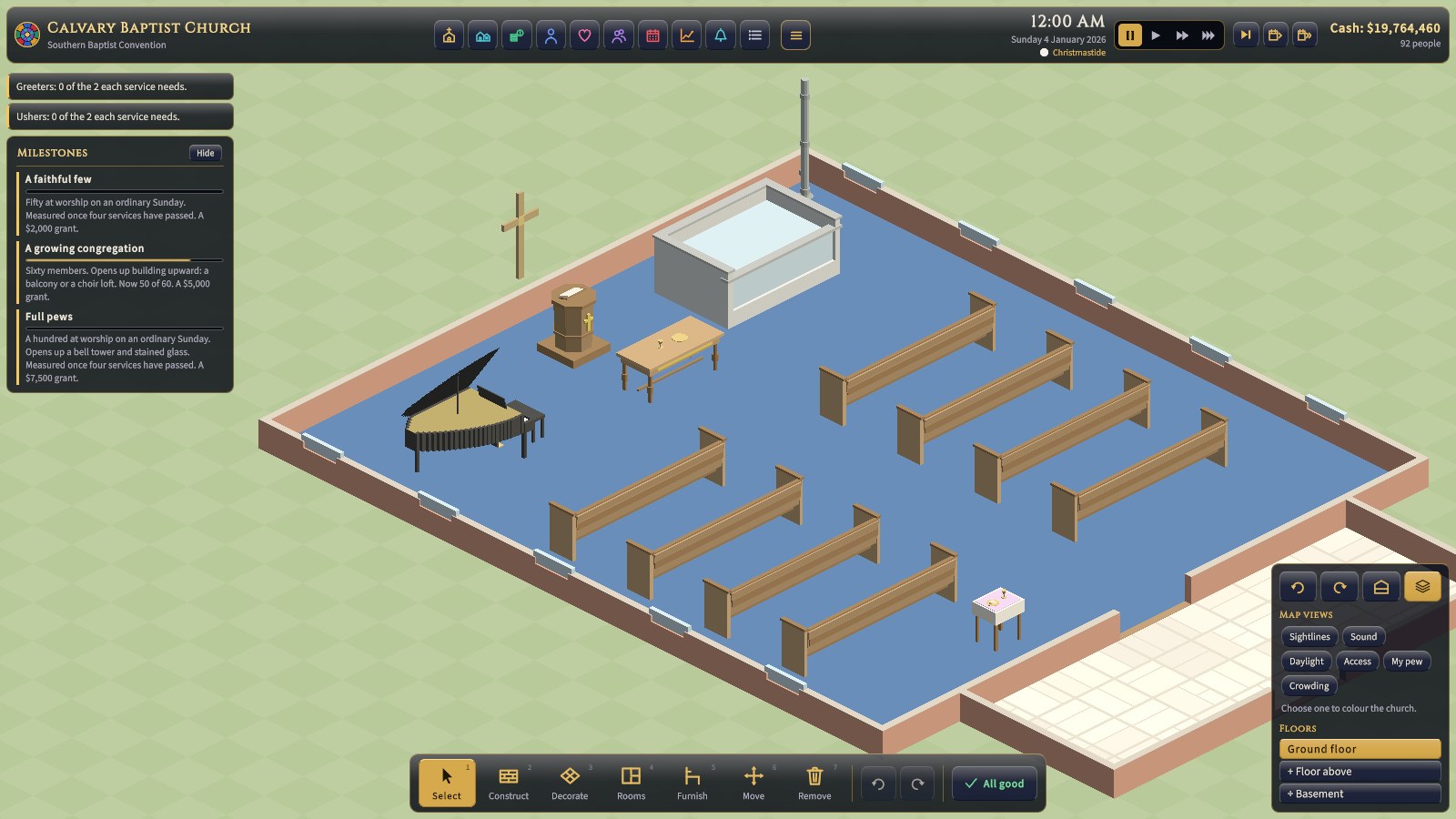
A free-church tradition: congregations govern themselves, baptize believers by immersion, and keep the Lord's Supper quarterly as a memorial. Worship centres on the sermon, with a Wednesday prayer meeting and Sunday school for all ages before the service. The Lottie Moon and Annie Armstrong offerings run in their seasons.
- Required: Pulpit, Communion table, Baptistry (with a Plumbing stack within 12 m).
- Expected: Upright piano (or a Grand piano), Communion trays.
- Discouraged: statues, icons, a Crucifix.
- Fits best: pianos (+1), chairs and the projection screen (+0.33), drum kit and sound system (+0.17).
The members decide almost everything, including calling the pastor, so keep them happy before any big proposal. Pastors are men and plentiful, so a search is short (six months, with an interim). Southern Baptists don't pledge: people give in the plate and the boxes as they come, so income follows attendance. The Cooperative Program (4.67%) is voluntary, and nothing turns on it for your own projects. The building is dry and gambling is forbidden.
American Baptist Churches USA
A preaching service with organ and choir, monthly communion passed in the pews, believers' baptism, and local options on nearly everything. A Black Baptist church is one of its variants.
- Required: Baptistry, Communion table, Pulpit, a sacristy.
- Expected: an organ, Choir stalls, Communion trays.
The members decide everything, receive new members by vote, and call the pastor (with an interim between). Members pledge; United Mission (4%) is voluntary. The denomination's stance isn't affirming, but its churches often depart from it, and yours can, at a cost in the region's regard; it can also become a Welcoming and Affirming church. Leaving costs nothing.
National Baptist Convention, USA
Black-church worship on Sunday at 11, a Wednesday prayer meeting, an afternoon service if you want it, walked offerings, Watch Night, and anniversaries and homecomings.
- Required: Baptistry, Communion table, Pulpit.
- Expected: a Hammond organ, a Upright piano, Choir stalls, Communion trays.
A strong pastor, called by the members and supported by a First Lady, usually stays until retirement, and the pastor's view sways every vote. The deacons are men. Association and convention dues ($1,200 a year) are voluntary. The congregation decides whether women preach and pastor. The Mothers' Board, the usher board, and the Missionary Society form as the church grows.
Pentecostal
Assemblies of God
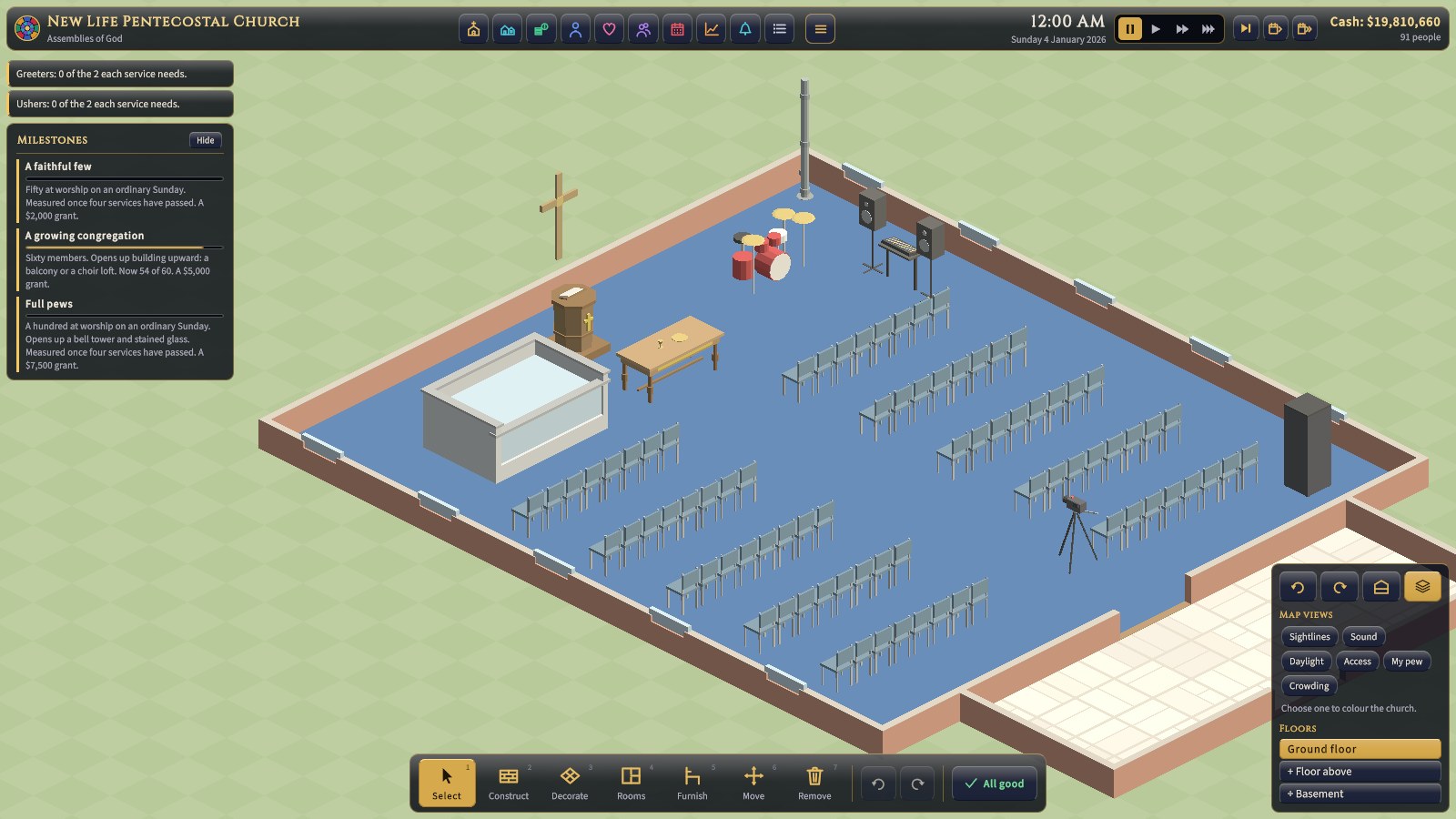
Long, band-led praise and worship, a long sermon, and a weekly altar call; believers' baptism by immersion; the Lord's Supper monthly; Christmas, Easter, and Pentecost kept; tarrying and healing services.
- Required: Pulpit, Communion table, Baptistry.
- Expected: Drum kit, Sound system, Communion trays.
- Discouraged: statues, icons, a crucifix.
- Fits best: chairs, drum kit, sound system, and the projection screen (+1). Every formal item scores −1.
The cheapest tradition to furnish. The members call a pastor by two thirds and approve new building by 60%, with a strong pastor's view swaying them; an associate takes over at once when the pastor goes. District support (3%) is voluntary, and the pastor's $600 dues come in their salary. A sovereign assembly that falls below 20 members, or to 30% regard, for six months becomes district-affiliated: the district appoints its pastor and decides its building. With 20 members, its way paid, and 50% regard for three months, it can vote to be sovereign again. Pentecostals want a dry room: carpet, and no Gothic stone. Watch the neighbours: drums and a sound system are noisy.
Church of God (Cleveland, Tennessee)
Praise and worship with a weekly altar call, quarterly communion with foot washing, Sunday evening and Wednesday services if you want them, and revivals and camp meetings.
- Required: Baptistry, Communion table, Foot-washing basins, Pulpit.
- Expected: a Upright piano, a Mercy seat, Communion trays.
The state bishop appoints the pastor, reviewed each year with the church's council consulted. The pastor decides renovations alone, and new building with the trustees' advice and the district's consent. The church sends 14% of its tithes up, and the pastor a tithe of their own (which they ask for in their pay). Women may pastor but not be bishops. Lodges, tobacco, alcohol, and gambling are forbidden. The wider body holds its ministers' credentials, so a church it regards badly loses its pastor, not its independence.
Church of God in Christ
Black-church worship with choir, organ, and band; a Tuesday prayer meeting and Friday and Sunday evening services; tarrying, shut-ins, prayer cloths, and Watch Night.
- Required: Baptistry, Communion table, Pulpit.
- Expected: a Hammond organ, a Upright piano, Choir stalls, a Drum kit, a Sound system, a Mercy seat, Foot-washing basins, Communion trays.
The jurisdictional bishop appoints the pastor for life (they retire after 35 years), trained by apprenticeship; below 150 at worship a church has a part-time one. The pastor decides renovations; the district decides new building. The district and jurisdictional reports ($1,200 and $3,000 a year) are required. Offerings are walked forward, fundraising is open, and the Women's Department, the YPWW, and the usher board are strong. The Holy Convocation each November holds its people.
International Pentecostal Holiness Church
Praise and worship with a weekly altar call, quarterly communion, optional foot washing, and camp meetings. A church of transfer members is one of its variants.
- Required: Baptistry, Communion table, Pulpit.
- Expected: a Drum kit, a Sound system, a Mercy seat, a cross, Foot-washing basins, Communion trays.
The conference nominates one pastor; the members ratify by two thirds and the conference consents. The Local Church Administrative Council (tithers) decides renovations. The church tithe and the ministers' tithe each send a tenth upward. Church elders, named by the pastor from the members, each care for 25 more people.
United Pentecostal Church International
A Oneness Pentecostal church: praise and worship Sunday morning and evening and a Wednesday prayer meeting, baptism in Jesus' name the moment someone responds, communion with foot washing twice a year, holiness dress, and a restricted view of entertainment.
- Required: Baptistry, Communion table, Foot-washing basins, Pulpit.
- Expected: a Hammond organ, a Drum kit, a Sound system, a Mercy seat, Communion trays.
The saints call a pastor, who serves for life with strong authority. The church board are tithers. Christmas for Christ ($1,500 a year) is voluntary, and the pastor's $900 dues come in their pay. Holiness dress holds people, but no dancing is allowed on the property and the youth ministry does less. The church recognizes only baptism in Jesus' name, so newcomers from other churches are baptized again.
Anabaptist, Moravian, and Friends
Mennonite Church USA
A preaching service with four-part singing unaccompanied, led by a song leader; believers' baptism by pouring; communion about quarterly, optional foot washing; peace at the heart of its witness.
- Required: Communion table, Baptismal font, Pulpit.
- Expected: Communion trays, Foot-washing basins. The national flag is discouraged.
The members decide and call. Conference giving (4%) is voluntary. A thrift store is offered as an institution, and the relief sale circle raises money each September. A ringing room helps unaccompanied singing. Whether the church is affirming is its conference's to decide, not the congregation's, and is fixed for the game.
Church of the Brethren
A preaching service on Sunday and, twice a year, the love feast: foot washing, a meal, and communion together at tables. Believers are baptized by triple immersion, the sick are anointed, and members affirm rather than swear.
- Required: Baptistry, Communion table, Foot-washing basins, Pulpit.
- Expected: a Upright piano, a fellowship hall and kitchen for the love feast.
The members decide and call. District support and the Core Ministries Fund (4% together) are voluntary. Peace and service are emphasised highly, and the building is dry. The denomination isn't affirming, but its churches often depart from that, and yours can, at a cost in the district's regard.
Moravian Church in America
A printed liturgy with organ, choir, and brass; communion about seven times a year; the lovefeast with buns and coffee, the Christmas Eve candle service, and Easter at sunrise. The Southern Province is one of its variants.
- Required: Communion table, Baptismal font, Pulpit, a sacristy.
- Expected: an organ, Choir stalls, brass band stands, Christmas Eve candles, Communion trays, a fellowship hall and kitchen.
The provincial board calls the pastor to the congregation, so the pastor is sent rather than advertised for. The board of trustees decides renovations; the members vote on new building with the province's consent. The Provincial Share (8%) is required. The church is affirming, but its congregations vary, and yours can depart from that, at a cost in regard.
Religious Society of Friends (Friends General Conference)
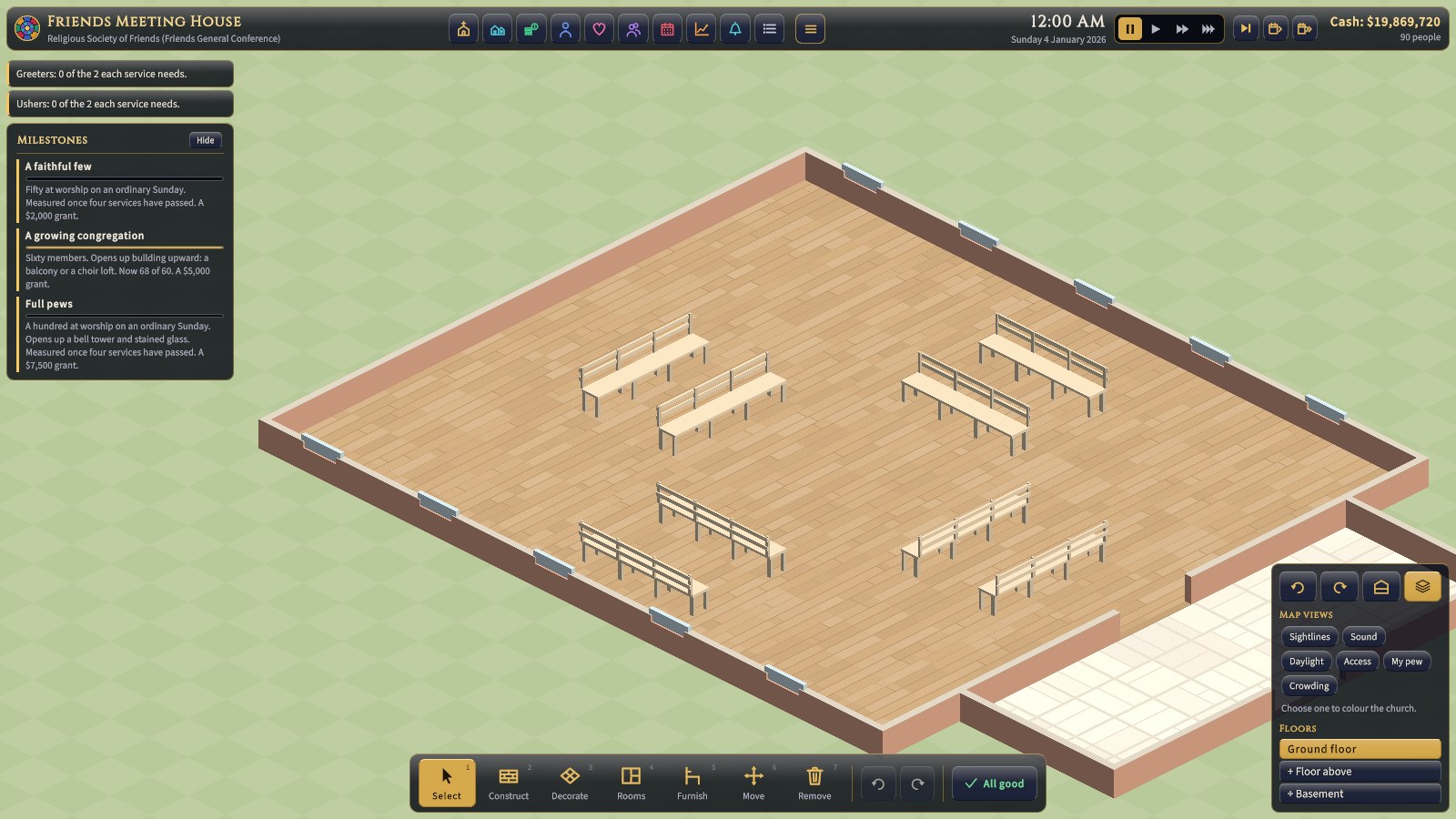
Friends gather in silence, facing one another, with no one appointed to lead. Anyone moved to speak rises and does so where they sit. No sacraments are observed outwardly, and there's no church year.
- Required: nothing beyond a narthex and a nave.
- Expected: meeting benches.
- Discouraged: a pulpit, organ, piano, drums, choir stalls, brass, crosses, statues, icons, flags, and paintings of Christ.
- Fits best: chairs (+1). Every formal or religious item −1.
No pastor needed (no preaching factor, and no penalty for its absence), almost nothing required, and only a voluntary covenant contribution ($60 a member). Giving is mailed or boxed, not passed. Attenders may serve on committees but don't decide. Decisions need consensus: no more than a tenth may object. Propose only what nearly everyone wants. The meeting decides whether it's affirming.
Friends United Meeting
A pastoral meeting: a pastor preaches, with a time of open worship within the service, a piano, Sunday school, and Christmas and Easter kept. No outward sacraments.
- Required: Pulpit.
- Expected: a Upright piano.
The pastor is part-time, recorded as a minister, and doesn't govern: the meeting decides everything, its pastor's call included, by consensus. The yearly meeting's apportionment (8%) is required. The denomination isn't affirming, but its meetings vary, and yours can depart from that, at a cost in regard.
Restorationist
Churches of Christ
The Lord's Day assembly morning and evening and a Wednesday Bible class; singing unaccompanied, as the New Testament church sang; the Lord's Supper every Sunday; baptism by immersion the moment someone responds; men lead in worship.
- Required: Baptistry, Communion table, Pulpit.
- Expected: Communion trays.
- Forbidden: every instrument (organs, piano, drums, brass, handbells), icons, and statues.
Each congregation is independent: there's no wider body, nothing owed, and no one above it. Up to five elders, men named from the members, lead it, and the elders (married men) decide everything by consensus, including hiring a preacher, who doesn't govern. Members don't vote. There are no fundraisers. The church recognizes only its own baptism. A ringing room makes the singing count for more.
Christian Churches and Churches of Christ
The instrumental churches of the same Restoration Movement, independent Christian churches with "No creed but Christ": the Lord's Supper every Sunday near the centre of the service, before the sermon, with an elder's short meditation at the table and the bread and cup passed along the pews; songs with piano and organ, or a band; an invitation every week, and believers immersed for the forgiveness of sins the moment they respond; Sunday school for all ages first, and a Sunday evening service and a Wednesday prayer meeting if you want them. A contemporary church is one of its variants.
- Required: Baptistry, Communion table, Pulpit.
- Expected: a Upright piano, a Lectern, Communion trays. Icons, statues, a crucifix, and the Hammond organ are discouraged.
- Fits best: pianos (+1), chairs and the projection screen (+0.33), drums and the sound system (+0.17). The pipe organ and choir stalls −0.17, formal items −0.33.
Like the Churches of Christ, each congregation stands alone: there's no wider body, nothing owed, and no one above it. Unlike them, the members vote. The elders (men named from the members) decide renovations and call the minister; the members vote on new building. Ministers come from the movement's Bible colleges, a little less skilled than seminary graduates and asking a little less, and the congregation ordains its own. The minister's view doesn't sway votes, and deacons from the members widen the care. The building is dry, the church keeps out of politics, and it can hold a revival each year. The congregation decides whether women minister. The youth group forms once there are five teenagers, and raises its way to a summer conference each June. A contemporary church holds two Sunday services (and Saturday evening if you want it) with a band and chairs, serves communion at stations as well, and has no members' vote, so its elders decide new building too.
Independent churches and networks
Independent nondenominational church
The pattern many independent churches share (not one body): two Sunday services of band-led praise and worship, a kids' ministry during, screens, online giving, and monthly communion. Baptistic, charismatic, and Reformed-leaning variants.
- Required: Baptistry, Communion table, Pulpit.
- Expected: a Drum kit and Sound system. Organs, choir stalls, and brass are discouraged.
No wider body and nothing owed. The elder board decides and calls, with a strong lead pastor's view swaying it; the lead pastor stays a long time, and an associate takes over when they go. Members don't vote. The church decides whether women lead.
Calvary Chapel
The movement Chuck Smith began at Costa Mesa in the Jesus movement. The pastor teaches the whole Bible verse by verse, Sunday morning and Wednesday evening, after a band-led set of worship songs; no plate is passed; communion monthly, after the teaching, passed in the pews; believers immersed, and each quarter the church goes down to the ocean or a river to baptize; children dedicated. The gifts of the Spirit are welcome, but tongues and prophecy are kept for a monthly afterglow, not the main service. (The game doesn't hold the afterglow or the quarterly baptisms yet: services of their own are yearly.)
- Required: Baptistry, Communion table, Pulpit.
- Expected: a Drum kit, a Sound system, Communion trays. Organs, choir stalls, and brass are discouraged.
- Fits best: chairs, drum kit, sound system, and the projection screen (+1). Every formal item, the organs, and stained glass −1.
In what Calvary calls the Moses model, the senior pastor leads: he decides renovations and new building himself, after a week's advice from the board, which stops the work only if most of it is against it. The board, men he trusts, calls the next pastor. There's no formal membership and no vote: everyone is a regular attender. Pastors are raised up within a church rather than sent to seminary, so candidates are a little less skilled and ask less; they stay a long time, and an associate takes over at once when one goes. Only men preach and pastor. People give at the box at the back and online, so visitors give nothing. The Association asks nothing of the church, and its only power is to end the affiliation, which it does once its regard has been below 0.15 for six months (a church that drifts far from Calvary's practice risks it). Leaving costs nothing.
Acts 29
A church-planting network, Reformed in its view of salvation: a casual, band-led preaching service on Sunday (and a second if you want it) around a long expository sermon; the Lord's Supper every week, by intinction at stations; believers immersed (a church that baptizes infants is one of its variants); the major days of the year kept; no altar call.
- Required: Baptistry, Communion table, Pulpit.
- Expected: a Drum kit and Sound system. Organs, choir stalls, brass, and paintings of Christ are discouraged.
A plurality of elders leads, men only: one paid lead pastor, advertised and called, and up to five elders named from the members. The elders decide renovations; new building and a call go from the elders to the covenant members for their consent. Membership is by covenant, under formal discipline, and asks much of its people. The covenant the elders renew with the network each year gives a tenth of the general offerings to church planting: 2% to Acts 29 itself, required, and 8% to plants the church chooses, voluntary. The network's regard rides on the 2%; it offers grants to a church in need that stands well with it, and it can't direct a church, only end its membership. Pastors are trained by residency and apprenticeship. Women don't preach or govern. Outreach is by invitation, home Bible studies, and planting churches, and the church commissions the plants it sends. Leaving takes a majority and costs nothing.
Charismatic
A family for churches between Pentecostal and evangelical: the Vineyard, ARC, and the nondenominational pattern's charismatic variant. Both bodies here are networks of independent churches, and each church owns its building.
Vineyard USA
The movement that grew from John Wimber's Anaheim church: one Sunday service of long, unhurried worship, a message, and then ministry time every week, when ordinary members pray at the front for anyone who comes forward; monthly communion at stations; believers immersed and children dedicated; members anoint the sick; Vineyard Kids during the service. A Spanish-speaking La Viña church is one of its variants.
- Required: Baptistry, Communion table, Pulpit.
- Expected: a Drum kit and Sound system. Organs, choir stalls, and brass are discouraged.
The church board decides building work, with a strong lead pastor's view swaying it, and calls the pastor; members don't vote. Pastors are licensed by the board, then ordained two years on and endorsed by Vineyard USA, which holds their credentials: a church it regards below 0.3 for three months loses its pastor. A married pastor's spouse leads alongside, and the two care for 75 more people. An associate takes over when the pastor goes. To keep the Vineyard name, the church gives 3% of its income to Vineyard USA, required. A church in good standing can have its grants; at 0.3 regard or less for six months it's found out of compliance, gets no help, and is watched more closely, until 0.5 for three months restores it. Below 0.15 for six months, it's disassociated. The church decides whether women pastor it. Leaving costs nothing.
Association of Related Churches
A network that plants churches and launches them large: two Sunday services, band-led and production-heavy, with an invitation to respond every week; believers immersed, with a baptism celebration each month; monthly communion at stations; tithing expected; and each year begun with 21 Days of Prayer and Fasting in January.
- Required: Baptistry, Communion table, Pulpit.
- Expected: a Drum kit and Sound system. Organs, choir stalls, and brass are discouraged.
Every church starts as a launching church, repaying its launch funding at 10% of income, required; ARC watches it closely and can lend to it from its launch funding. Once it has paid its own way (no help, and the last six months' books in the black) for two years running, it becomes a partner church, and owes nothing but a voluntary 2% toward the next plants. The lead pastor is always a married couple, trained by the network, who care for 75 more people together. The lead pastor decides renovations, after a week's advice from the trustees; the trustees decide new building, with the pastor's view swaying them; the elders call a successor. Members don't vote. Pastors stay a long time, and when one retires a son or daughter takes over. Women preach; the church decides whether they pastor. ARC claims no authority over its churches beyond ending the connection, and leaving costs nothing.
Distinct traditions
Seventh-day Adventist Church
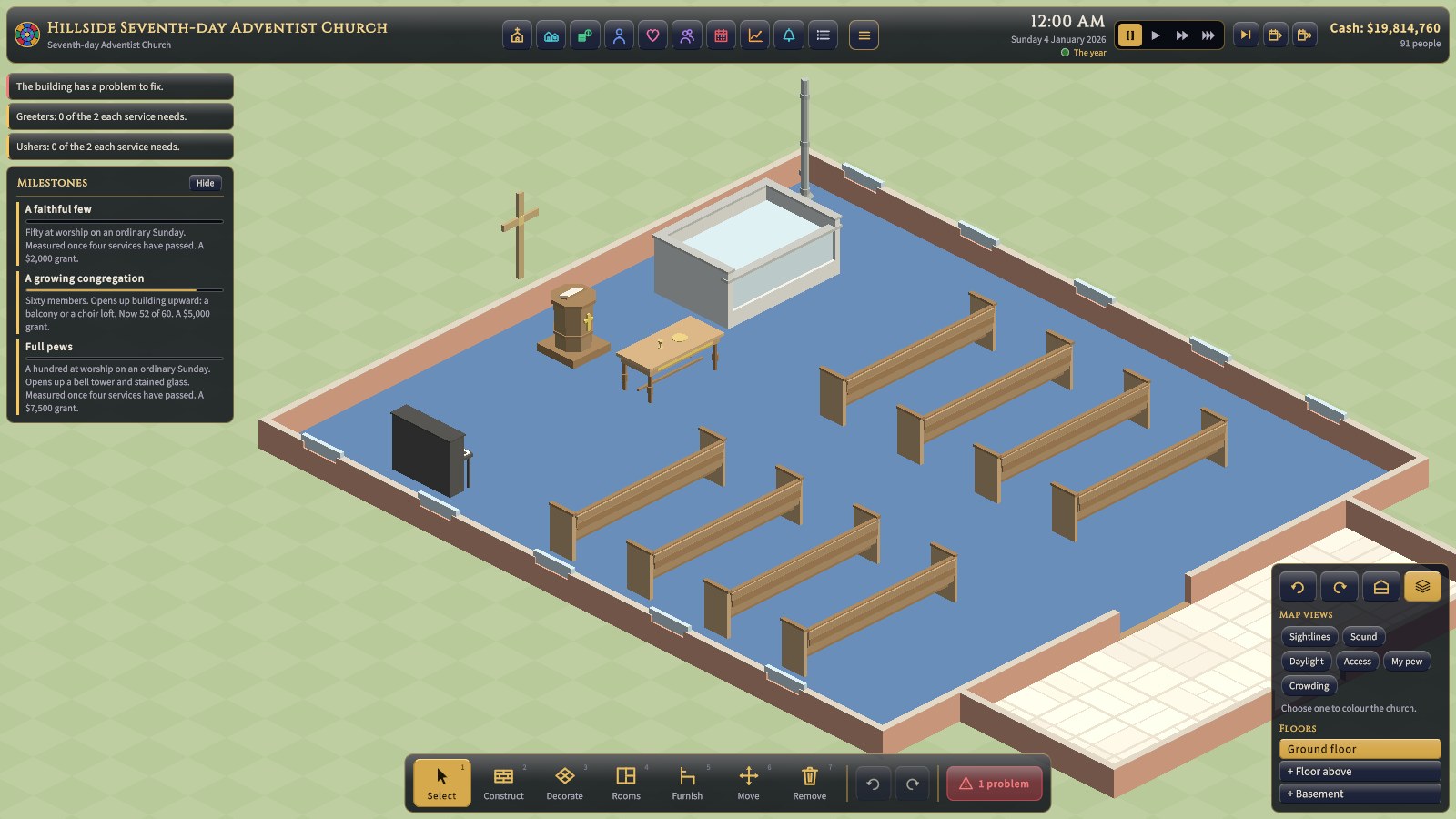
Adventists keep the seventh-day Sabbath, from sunset on Friday to sunset on Saturday, so the church meets on Saturday: Sabbath School first, then the worship service. Believers are baptized by immersion, and the Lord's Supper, with foot-washing (the ordinance of humility) beforehand, comes once a quarter. The church keeps its own year, with Christmas and Easter, and the Ingathering appeal.
- Required: Pulpit, Communion table, Baptistry (with a Plumbing stack within 12 m), Foot-washing basins.
- Expected: Upright piano (or a Grand piano), Communion trays.
- Discouraged: statues, icons, a Crucifix, the national flag.
- Fits best: pianos (+1), formal items (+0.33), choir stalls and the pipe organ (+0.17). Chairs and the projection screen −0.33.
Choosing the tradition moves your services and Sabbath School to Saturday; a service you put back on a Sunday costs everyone at it (−0.12). The members vote on renovations, but the conference decides new building and sends the pastor, who is shared below 60. The tithe to the conference, 15% of income, is the heaviest obligation of any tradition, but the conference pays the pastor from it. A parish school is offered, a fifth of it paid by the conference; outreach is by evangelistic series and literature; the Pathfinders and Women's Ministries form. Meals are vegetarian (cheaper), fewer stay for coffee, the Sabbath keeps weddings and tenants away, and tenants pay 15% less for it.
The Church of Jesus Christ of Latter-day Saints
Sacrament meeting each Sunday, with bread and water, then Sunday School; Christmas and Easter kept; no crosses; a cultural hall in every meetinghouse.
- Required: Baptistry, Communion table, Pulpit, a cultural hall.
- Expected: an organ, Communion trays.
- Forbidden: crosses of every form, and the crucifix.
The stake calls a member as bishop, unpaid, for five years, with two counselors; there are no paid clergy. The bishop decides renovations; the stake decides new building. The Church funds the ward centrally: offerings go up, and a budget ($25 for each active person a month) and the building's costs come down. The meetinghouse is shared with other wards: they have it on Sunday from noon to five and pay two thirds of its running costs, and members clean it, so keep your own meetings in the morning. Fast offerings are given on each month; there are no fundraisers. Young adults go out as missionaries for two years, the temple holds families, and the Relief Society is strong. Caffeine is forbidden (a fifth fewer stay for coffee). A ward of 40 members or fewer for a year becomes a branch, led by a branch president; at 120 it's a ward again. It can't vote to leave.
Jehovah's Witnesses
The weekend meeting on Sunday and the midweek meeting on Thursday in a Kingdom Hall, recorded music, and once a year the Memorial of Christ's death, when the bread and wine are passed and only the anointed partake. No crosses, no flags, no holidays.
- Required: Communion table, Pulpit.
- Expected: a Sound system, Communion trays.
- Forbidden: crosses of every form, the crucifix, icons, statues, the national flag.
A body of unpaid elders (baptized men named from the congregation and appointed by the circuit) leads, with ministerial servants. Publishers report their service each month, and the circuit's regard follows how many come (up where seven in ten do, down below half). Commitment is total: people come more, serve more, and seldom drift, and those who leave are shunned, which costs their friends. Outreach is door to door, home Bible studies, and literature; giving is by contribution boxes only, so visitors give nothing; there are no fundraisers; donations to the worldwide work (25%) are voluntary. The Kingdom Hall is shared on a schedule. Blood drives, parties, polling places, and anything patriotic are ruled out. It can't vote to leave.
Church of Christ, Scientist
The Lesson-Sermon, read on Sunday by two Readers from desks, with no sermon of anyone's own; the Wednesday testimony meeting; Sunday School during the service; an organ; no sacraments; a Reading Room open to the public; healing by prayer.
- Required: Readers' desks, a Reading Room.
- Expected: an organ.
- Discouraged: a pulpit, crosses, statues, icons, choir stalls, the band, flags.
The members elect two Readers from among themselves, unpaid, for three years; there's no sermon topic to choose, since the Lesson-Sermon is set. The members decide everything else. The per capita tax ($1 a member) is paid by members themselves. Outreach is the Reading Room's literature. No health clinic, alcohol, or tobacco on the property.
Unitarian Universalist Association
A covenantal, non-creedal faith drawing on many sources: the Sunday service opens by lighting the flaming chalice, with joys and concerns, the flower and water communions in their seasons, and religious education during the service. A lay-led fellowship is one of its variants.
- Required: the Flaming chalice, a Pulpit.
- Expected: a Upright piano. Crosses, the crucifix, icons, and paintings of Christ are discouraged.
The members call a minister by 90% (with an interim between) and approve new building by two thirds. Members pledge; the share plate gives 5% of each offering on; fundraising is open, and renting space is usual. The Annual Program Fund (6.75%) is voluntary, but giving less than half of it means no help from the Association. The church is affirming, and can be recognized as a Welcoming Congregation.
The denomination
Church → Denomination shows the wider body over the church: its levels and their leaders (the diocese and its bishop, the district and its superintendent), its regard for the church and how often its leader visits, the church's status, any supervision, closure warning, or merger on offer, the places its people go, what it can make the church do, what the church owes it and what not keeping it costs, the help it gives, what it's done lately, and leaving it. A church with no wider body (Churches of Christ, the Christian Churches, the nondenominational church) is told so.
Its regard for the church
The wider body's regard for your church runs from 0 to 1. It falls with unpaid obligations whose consequence is its regard, and with drift from the tradition (below). It rises a little for a missionary sent (+0.05), a church planted (+0.1), a merger accepted (+0.1), each month a ministry of a kind the tradition values highly runs, and a visit that finds the building well kept. It falls a little for asking for a new pastor (−0.05), turning down a merger (−0.1), and a visit that finds the building neglected. How fast it follows what you do depends on the wider body's presence: a fifth of the way each month where it's strong, half that where it's light, half as quickly again where it's total (AME, Latter-day Saints), and not at all where there's none.
| Regard | What follows |
|---|---|
| Below 0.7 | It won't approve or consent to your projects or calls, won't help, and won't move your pastor at your asking. |
| Below 0.5 | It says it's troubled, and its visits strain those at the service instead of lifting them. |
| Below 0.3 for three months | It acts, as its powers allow (below). |
| Below 0.15 for six months | A body that can expel churches, and doesn't hold the property, expels yours. |
What the church owes
Each tradition's wider body asks for one or more obligations, each listed on the Denomination tab with its basis (a share of income or of tithes, a sum for each member, a yearly levy or goal), who pays it, and what not keeping it costs.
- Required obligations the church pays together, at the share you choose on Finances → Budget (0% to 200%: more than 100% pays off arrears). What goes unpaid builds arrears, and an obligation is not kept once its arrears pass three months of it.
- Voluntary obligations (the Cooperative Program, the ELCA's mission support, the Annual Program Fund) each have their own setting, from none to 150%. Giving less than half counts as not keeping it, where that has a consequence.
- Paid by members: what members pay upward themselves (Christian Science's per capita tax) comes out of what they'd give the church. Paid by clergy: ministers' dues and tithes, which the pastor asks for in their salary.
What not keeping one costs is one of: the wider body's regard (a year of paying nothing to a Catholic diocese drops it to about 0.1); no aid (the Unitarian Universalists' Annual Program Fund); or no voice (the Episcopal, Orthodox, and AME churches' assessments, the National Baptist dues), so the wider body turns down the church's projects and sends it the weakest pastor. Paying half in a crisis month is a reasonable compromise; paying nothing for long is not.
Visits and requests
Where it's present, the wider body's leader visits on a Sunday: once a year where its presence is light, twice where strong, four times where total. Those at the main service are lifted (+0.03) where it regards the church at 0.5 or more, and strained (−0.02) where it doesn't. Its review follows the building: condition 0.6 or more raises its regard, below 0.4 lowers it. It also asks things, as dilemmas: a special appeal, and where its presence is strong, hosting the regional gathering or the annual report.
Help in need
Many wider bodies help a church that stands well with them (0.7 or more, and not behind on an obligation that costs it aid). The Denomination tab offers what yours gives:
- A grant of three months' expenses (up to $30,000), once in three years, for a church with less than three months' expenses in hand.
- A loan of $50,000, $100,000, or $250,000 at 3% over 15 years, one at a time: half the bank's rate.
- Help with the pastor's pay: 40% of their salary for three years, for a church in need.
What it can make the church do
Each wider body's powers are its own, and the Denomination tab lists them. After three months of regard below 0.3:
- Withdraw the pastor's credentials, where the wider body holds its ministers' standing rather than the church's (the American Baptists, Assemblies of God, Christian Reformed, Church of God, ELCA, Missouri Synod, Mennonites, UCC, United Pentecostals, Unitarian Universalists, Vineyard USA). The pastor must step down, and the matter is treated as settled (its regard recovers a little). At most once in two years.
- Take the church into its supervision, where it can (Catholic, Ukrainian Catholic, Orthodox, Coptic, Episcopal, Presbyterian, COGIC, Moravian, Nazarene). Every project and the pastor are its to decide until its regard has been above 0.6 for three months. Where the tradition has a supervised status (an Episcopal mission, a Nazarene church with an appointed pastor), the church moves to it. (An Assembly of God in trouble goes to the district by its status instead, below.)
- Remove the pastor the church called and send its own, where it can remove leaders.
And for a church of fewer than 20 active people for a year: where the wider body can merge churches, it offers to merge another struggling congregation into yours (three to six households join; you have 60 days to answer, and turning it down costs 0.1 of its regard). Where it can close churches, it warns you, and a year later, still small, it closes the church, which loses a scenario.
Statuses
Some traditions have affiliations a church moves between, each changing how it's governed:
| Tradition | Status | Moves |
|---|---|---|
| Assemblies of God | Sovereign / district-affiliated | To district-affiliated below 20 members or at 30% regard for six months; back by the members' vote with 20 members, its way paid, and 50% regard for three months. |
| Episcopal | Parish / mission | To a mission at 15 members for a year or 25% regard for six months; back by vote at 40 members, its way paid, 50% regard for six months. |
| Nazarene | Calling its pastor / an appointed pastor | To appointed below 35 members or at 30% regard for six months; back by vote at 35 members, its way paid, 50% regard for three months. |
| Latter-day Saints | Ward / branch | To a branch at 40 members or fewer for a year; to a ward at 120 for six months. |
| ARC | Launching church / partner church | Every church starts launching, repaying its launch funding at 10% of income; ARC makes it a partner once it has paid its own way (no help, and six months' books in the black) for two years running. A partner owes only a voluntary 2%. |
| Vineyard USA | Good standing / out of compliance | Out of compliance at 0.3 regard or less for six months: no help, and its regard follows what the church does faster; back in good standing at 0.5 for three months. |
A vote to move carries if most adult members are content (0.5 or more). ARC's and the Vineyard's moves are the wider body's, with no vote.
Funding and property
- Central funding (the Salvation Army, Latter-day Saints): each month's offerings go up, and a budget of $25 for each active person, plus the building's costs, comes down. Growth is what raises your budget.
- The tithe goes up (Adventists): 15% of income to the conference, which pays the pastor.
- Property it owns (the Catholic and Ukrainian Catholic churches, the Adventists, the Witnesses): it insures the building.
- A shared hall (Latter-day Saints, Witnesses): other congregations have it on the main day from noon to five, pay two thirds of its utilities and upkeep, and its members clean it, so there's no sexton.
Practice and doctrine
Changing practice
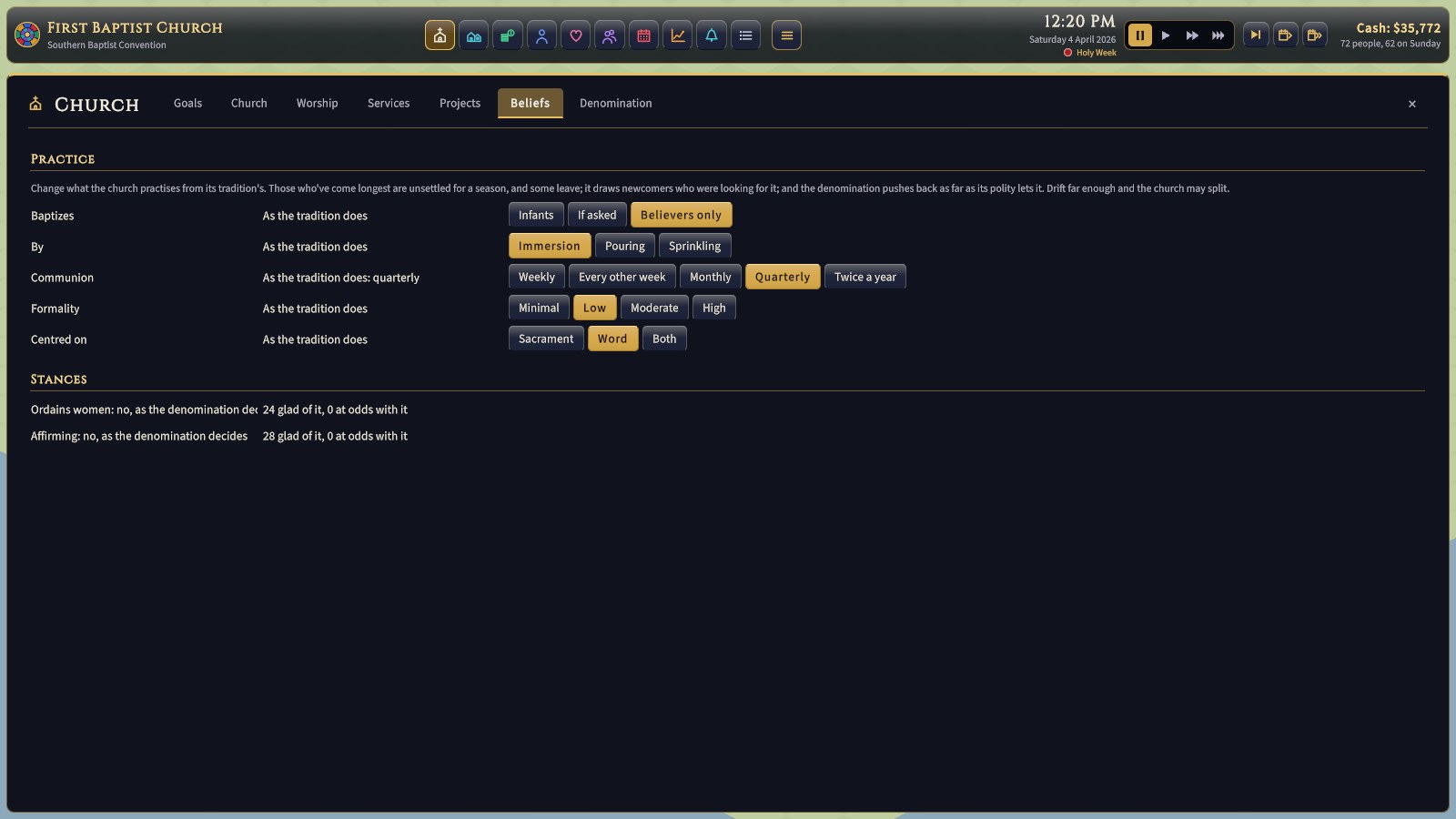
On Church → Beliefs you can change the church's practice from its tradition's: who is baptized and how, how often communion is celebrated (weekly, every other week, monthly, quarterly, or twice a year), how formal worship is, and what it centres on. Each change has a size: who is baptized 1, how 0.4, each step of communion frequency 0.2 (every other week is half a step from weekly), of formality 0.25, a change of focus 0.3 or 0.6.
- Where doctrine is held centrally (the Catholic, Ukrainian Catholic, Orthodox, Coptic, and Episcopal churches, the Church of God and COGIC, the Adventists, Latter-day Saints, Witnesses, Christian Science, the Salvation Army), the sacraments and what worship centres on are the whole church's: only how formally you worship is yours to change.
- The building follows. A Baptist church that starts baptizing infants (still by immersion) needs an Immersion font; the building check updates at once.
- Long-standing members are unsettled for 13 weeks (−0.08 a week), more likely the longer they've come. When it settles, each unsettled household leaves with up to a 30% chance.
- It draws newcomers looking for just that: up to half as many again, for a year.
- The denomination pushes back. Its regard moves toward 1 minus the distance drifted times 0.6 where doctrine is held centrally, 0.45 where it's confessional, or 0.2 where each congregation decides, as fast as its presence.
- Change your mind within the 13 weeks and nothing settles.
Practice changes are powerful but expensive. Make one big change, not many small ones, and make it when the congregation is young in tenure and the money is good. Churches under a bishop pay a much higher price in standing.
Social stances
Each tradition says whether its churches ordain women and whether they're affirming, or leaves it to each congregation. Where it's left to you (the affirming question in the ELCA, UCC, United Methodist, and Friends General Conference churches; women's ordination in the Christian Reformed, National Baptist, Christian Churches, Vineyard, ARC, and nondenominational churches), Church → Beliefs has Yes and No. Each person has a view. Those who hold a strong view (beyond 0.4 from the middle) feel the church's practice after every service: up to −0.2 if at odds, +0.06 if in accord. Visiting households at odds come back less than half as often and never join.
The Beliefs tab shows how many of your people are glad and how many are at odds with each choice. The game takes no side. Each choice shapes who joins you over the years, and the wider community newcomers come from is evenly split.
- Local variance. Where a tradition's churches often depart from its stance on being affirming (the Catholic, Episcopal, Presbyterian, Moravian, American Baptist, Brethren, Friends United Meeting, and nondenominational churches), yours can too, with Yes and No, but the wider body holds it against you: as much as half a change in who is baptized, by its pushback.
- Where the region decides (Mennonite Church USA), the congregation can't: the church is as its conference is, fixed for the game.
- Who serves. Where women may not govern, they're not on boards; where they may preach but not pastor, they can be associate pastors; where they may not hold the highest office, a woman stays a rung below it.
- Two kinds of leaning. A sermon leans on moral questions or economic ones, and some traditions lean differently on each: Catholics, conservative on moral questions and liberal on economic ones, take a sermon on social justice well (see Worship and the church year).
Designations
Some traditions offer a public designation a congregation adopts by its own vote: Reconciling in Christ (ELCA), a Reconciling Congregation (United Methodist), Open and Affirming and a Just Peace church (UCC), a Welcoming Congregation (Unitarian Universalist), and a Welcoming and Affirming Baptist church (American Baptist). Put it to the members on Church → Beliefs; members vote for it as far as they'd like the church to take its stance, and a majority carries it. Once adopted, the church takes the stance, draws more newcomers for a year (a fifth more for most), gains a little standing, and some households at odds with it leave (a quarter of them for most, three in ten for a Welcoming and Affirming Baptist church, a tenth for a Welcoming Congregation). A Just Peace church takes no stance, draws fewer newcomers, and loses no one over it.
Belonging and giving
- Kinds of belonging. Each tradition has its own: confirmed and baptized members, voting members and parishioners, senior soldiers and adherents, baptized and unbaptized publishers, Friends and attenders. The People screen counts each, and says who votes, who may hold office, and who counts for what's owed per member.
- Commitment. Where a tradition asks much of its people (high, or total for the Witnesses), they come more faithfully (6%, or 10%, more often), serve more, drift less, and join more slowly; where it asks little (the ELCA), the reverse.
- What holds people. Formal discipline (and members below 0.3 are taken off the rolls each January), shunning (a household's leaving costs its friends), belonging where one lives (and the wider body divides a parish of 450), an exclusive belonging, holiness dress, a uniform, and the wider body's places all make households drift away less.
- Tithing. Where it's expected, people give 15% more; where it isn't emphasised, 10% less.
- How it's given. Where the tradition doesn't pledge, there's no pledge drive, and people give in the plate each week they come. A walked offering brings 15% more from members and half as much again from visitors; contribution boxes alone bring a tenth less and nothing from visitors; mailed or private giving comes in at the month's start; online givers give whether they come or not (8% more).
- Newcomers from other churches. About half of newcomers come from another church, of any tradition. The more alike it is to yours (worship most, then the sacraments, doctrine and scripture, polity, and family least), the likelier they come back, and from one much like yours they settle in sooner. A church that recognizes only its own baptism baptizes those from churches unlike it again.
Schism and leaving the denomination
Drift 1.5 or more from the tradition, and a change that settles with a third or more of the church still unsettled splits it: every unsettled household leaves together.
Or the church can leave its denomination, from Church → Denomination: Propose leaving…, then Put it to the members. It goes to the members as the tradition's exit rule says, then to the wider body where it must consent (it consents once the settlement can be paid). Members vote to leave the further the church has drifted and the worse the wider body regards it, and less the longer they've belonged.
- Can't vote to leave: Catholic, Ukrainian Catholic, and Coptic parishes, Latter-day Saint wards, Witnesses congregations, and Salvation Army corps (their property and leaders are the wider body's).
- Two votes: the ELCA (two thirds each, three months apart) and the Christian Reformed (a month apart). Two thirds: American Baptist, Assemblies of God, Episcopal, Missouri Synod, Moravian, Orthodox, United Methodist, Unitarian Universalist. Everyone: both Friends bodies. The rest, a majority.
- What it costs: where the wider body holds the property, the church must buy it out, of the building's worth ($2,000 a square metre enclosed), plus anything owed: all of it where the building would stay behind (Episcopal, AME, Free Methodist, Nazarene, Brethren, Moravian, the Pentecostal bodies that hold property in trust, the Adventists); half by negotiation (Orthodox, Presbyterian); 30% by formula (United Methodist). Where the church owns its own and the wider body asks no buy-out (the ELCA, the Christian Reformed), it pays only what it owes. Where the wider body's claim wouldn't hold up (the Baptists, Missouri Synod, Mennonites, UCC, Unitarian Universalists, both Friends bodies, Christian Science, Assemblies of God, United Pentecostals, and the four networks with a body to leave: Calvary Chapel, Acts 29, Vineyard USA, ARC), it costs nothing at all. The church can't leave without the money.
Once it's carried, the church governs itself: the congregation decides what the polity used to, it owes nothing (arrears are settled), its standing no longer matters, any support ends, and it decides its own stances, keeping what it practised. Some of those most attached to the tradition stay with it: each household leaves with a chance of up to 50% by how long its adults have come, less the further the church had already drifted.
Founding a tradition of your own
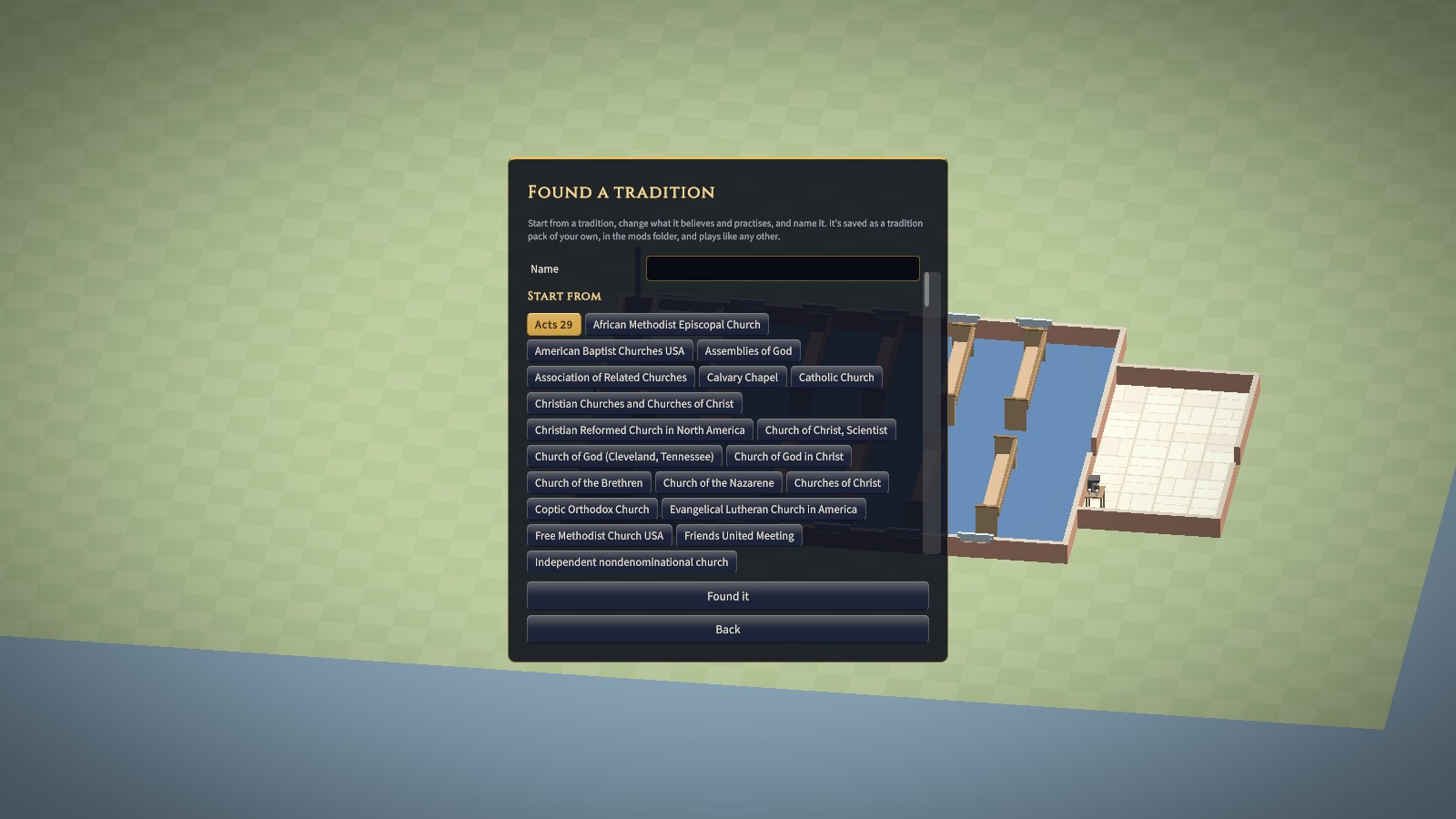
Mods → Found a tradition, or Found a tradition of your own… on the sandbox screen, lets you start from any tradition, change any of its attributes, name it, and found it. It's then chosen for a new sandbox game. The game checks it as it checks its own content: baptism and communion must be described if and only if they're observed, and nothing can be both wanted and forbidden.
Your tradition is saved as a tradition pack in the mods folder (my-traditions.rjpak), in exactly the format of the game's own; decompiled, it's a good starting point for a pack to share. Founding one of the same name again replaces it.
Tradition packs
Communities can add their own traditions, and correct the details of others, with tradition packs: content loaded from the mods folder, either a folder of files or a single .rjpak pack file compiled from one. No programming is needed. The Mods screen shows where the folder is (with Open the folder and Reload), what's installed, and any problems in it. The game comes with a sample pack, the made-up Meadow Brethren of the modding guide, in its SampleMods folder (meadow-brethren.rjpak): copy it into the mods folder to play it. A pack that's been damaged or edited is refused, and the Mods screen says so. A mod's item replaces the game's item with the same ID. Packs made for the game's earlier traditions are refused with a message saying they need updating.