Chapter 10
Staff and volunteers
Staff cost more than anything else a church buys, and the right ones are worth it: a great preacher lifts everyone every week. How your clergy come, how long they stay, and who pays them is your tradition's to say, and this chapter shows each way. Volunteers cost nothing at all, and are among the best value in the game, as long as you don't wear them out.
Staff
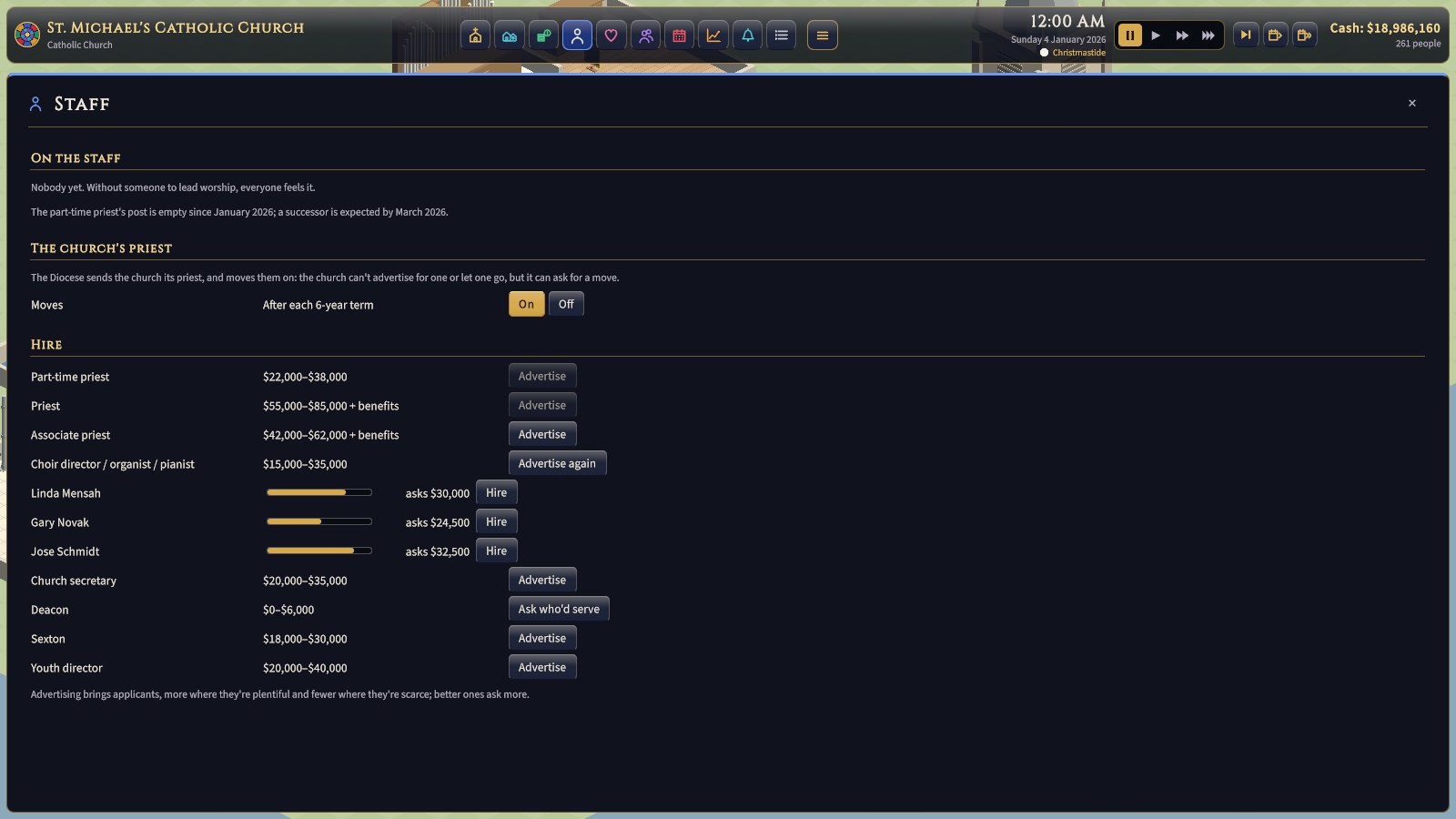
| Role | Salary a year | What they do |
|---|---|---|
| Pastor (full time) | $55,000–$85,000 + $18,000 benefits | Preaches, leads worship, and cares for the congregation. Can know about 150 people well. |
| Bivocational pastor | $22,000–$38,000 | Preaches and leads worship part-time, alongside another job, as most small churches' pastors do. Can know about 75 people well. |
| Associate pastor (full time) | $42,000–$62,000 + $15,000 benefits | A second pastor, who preaches some Sundays and shares the care. Can know about 100 people well. Only where your clergy are paid. |
| Lay leader | unpaid | A member called to lead, alongside their own work: an elder, a Reader, a bishop of a ward. Can know about 60 people well. Only where your tradition's leaders are unpaid, plural, or called from the members. |
| Deacon, local elder, and other assisting orders | unpaid (a deacon up to $6,000) | Named from the members, where your tradition has them. Each cares for 30 more people (an IPHC church elder, 25). |
| Choir director / organist / pianist | $15,000–$35,000 | Plays the organ or piano, directs the choir, and chooses the music. Up to +0.06 for everyone. Part time. |
| Youth director | $20,000–$40,000 | Runs the youth group and keeps teenagers coming. Up to +0.08 for households with someone under 19 (a tenth less where the tradition is discerning about entertainment, 30% less where it keeps its young from films and dances). Part time. |
| Sexton | $18,000–$30,000 | Opens up, cleans, and fixes small things before they become big ones. Slows building wear by up to half. Part time. None where congregations share a hall, since its members clean it. |
| Church secretary | $20,000–$35,000 | Runs the office, the bulletin, and the calendar, so the pastor can be a pastor. The pastor can care for 50 more people. Part time. |
Payroll taxes add 7.65% to every salary. The Staff screen calls your clergy what your tradition does: a Catholic parish hires no "pastor" but has its priest, a part-time priest, or an associate priest, and a Salvation Army corps has its corps officers. The assisting orders go by their own names too: the Free Methodists' consecrated deacons, the Witnesses' ministerial servants, a Latter-day Saint bishop's counselors, the Army's Corps Sergeant-Major.
Hiring
- Advertise a role and three applicants apply, with skills from 0.3 to 0.95. Better ones ask for more. Hire the one you want, or Advertise again for a new three. A role filled from the members shows Ask who'd serve instead: the candidates are your longest-standing members of 25 to 75, more skilled the longer they've belonged.
- A skilled pastor is worth paying for. Preaching moves everyone by (performance − 0.5) × 0.16, so the swing from a poor preacher to a great one is 0.16 for everyone, every week. That's more than the whole building's fit.
Your clergy, as your tradition has them
The top of the Staff screen says how your church's leader comes, and the hire list follows it. There are six ways.
| How the leader comes | What you do | Traditions |
|---|---|---|
| Advertised and called | Advertise, then Call the one you want. The call is a proposal: it goes to whoever calls in your tradition, and the pastor starts only if it carries (see Projects, approvals and conflict). | The Baptists (Southern, American, National), Assemblies of God, ELCA, Presbyterians, Christian Reformed, UCC, Episcopal, Nazarenes, Brethren, Mennonites, United Pentecostals, Unitarian Universalists, Friends United Meeting, the nondenominational church, Calvary Chapel, the Christian Churches, Vineyard USA, ARC |
| Nominated | The wider body puts forward one nominee. Call them, or advertise again for another. | Missouri Synod Lutherans, Pentecostal Holiness |
| Named from the members | Ask who'd serve: your own members are the candidates, and the wider body consents where it ordains them. | Coptic Orthodox (a priest ordained from the parish, for life), Christian Science (two Readers), Churches of Christ (up to five elders beside one paid minister), Acts 29 (up to five elders beside a paid lead pastor, who is advertised and called), Jehovah's Witnesses (a body of unpaid elders) |
| Sent | Nothing: the wider body sends one, and moves them on. You can't advertise for or dismiss a leader it sent, but you can ask for a move. | Catholic, Orthodox (OCA), Ukrainian Catholic, United Methodist, AME, Free Methodist, Church of God (Cleveland), COGIC, Seventh-day Adventist, Salvation Army, Moravian |
| A member called to lead | Nothing: the wider body calls one of your members, unpaid, for a term (five years). | Latter-day Saints (the bishop) |
| None | Nothing: the meeting has a clerk, not a pastor, and misses no one. | Friends (FGC) |
Dismissing the church's leader (Ask to dismiss on the Staff screen) goes to whoever calls them in your tradition: the members' vote, a board, or the wider body. Never the leader alone. The less content the congregation, the likelier it carries: about half at 50% satisfaction, three in four at 30%. If it carries, they go with a month's pay. Other staff, and an interim, are let go at once.
Making a bivocational pastor full-time (Make full-time) makes them the church's full-time pastor, with its benefits, at a quarter more pay, at least the full-time pastor's least ($55,000). It goes to the same decision as a call, weighing their skill against what it costs. A full-time pastor can know about 150 people well, against a bivocational pastor's 75.
Asking for a move (Staff screen, for a leader who was sent) works once they've been with you two years and the wider body regards you at 70% or more. It costs the church a little of that regard (5%), and a successor comes within two months.
The candidates
- How many apply. Usually three. Two where clergy are scarce (Catholic and Orthodox priests, Ukrainian Catholic priests), four where they're plentiful (Southern and National Baptist pastors). Two from a wider body's vetted list (ELCA, Presbyterians, Christian Reformed), a little more skilled for it. One fewer where clergy must be celibate.
- Their training sets their skill and what they ask:
Training Skill Pay asked Seminary as usual 100% In-house (Salvation Army, the nondenominational church, ARC) as usual 90% College (the Christian Churches, Churches of Christ, United Pentecostals), or an ordination council (Southern and National Baptists) −0.03 95% A course of study (AME, Assemblies of God, Church of God, Nazarenes, IPHC, Friends United Meeting) −0.05 90% Apprenticeship (COGIC, Calvary Chapel, Vineyard, Acts 29) −0.06 85% - Women are among the candidates only where the church ordains women, about a third of them. Where women may preach but not pastor, they can still be associate pastors.
- Spouses. Candidates are married or not as the tradition has it: never where clergy must be celibate, nine in ten where marriage is expected, seven in ten otherwise. Salvation Army officers, and an ARC church's lead pastor, always serve as a married couple.
- Rank. Where the tradition has a credential ladder (licensed, then ordained; lieutenant, captain, major), each candidate holds a rank by their skill.
What they're paid
- The wider body's scale. Catholic, Ukrainian Catholic, Adventist, and Salvation Army clergy are paid what the scale sets for their rank, not what they ask.
- The parsonage. Where the church houses its pastor, candidates ask 12% less, and the parsonage costs $900 a month to keep up (three quarters of that for a celibate priest). Where your tradition leaves it to you, the Staff screen has a Housing setting: Parsonage or Allowance.
- Dues and tithes they pay upward. A pastor who owes the wider body ministers' dues (Assemblies of God $600 a year, United Pentecostal $900) or a ministers' tithe (a tenth of pay: Church of God, IPHC) asks for it on top of their salary.
- A minimum. A full-time Presbyterian pastor is never paid under $50,000, a United Methodist one under $48,000.
- Paid from above. Where the tithe goes up to the conference (Adventists) or the wider body funds the church (Salvation Army), the wider body pays the clergy and the church pays nothing for them.
Shared pastors and part-time ones
Where a tradition shares small churches' pastors (Catholic, Ukrainian Catholic, United Methodist, AME, Missouri Synod, Adventist), a full-time pastor of a church below the tradition's full-time attendance (60 unless it says otherwise) serves another church too. You pay half their salary and have half their care, and they lead only the first service each week: those at your later services miss them a little (−0.03). It's looked at again each July, so growing past the line brings them back to you. Where the wider body sends pastors and doesn't share them, a small church is sent a part-time one.
Spouses, ranks, and assisting orders
- A recognized spouse (the First Lady of an AME, COGIC, or National Baptist church; the pastor's wife in the Assemblies, a Southern Baptist, a Calvary Chapel, an Acts 29, or a nondenominational church; the priest's wife in the Orthodox, Coptic, and Ukrainian Catholic churches) lifts every adult a little after each service (+0.01), where the leader is married.
- A couple serving together (Salvation Army officers, an ARC church's lead pastor and spouse) care for 75 more people than one could, and so does a married pastor where the spouse leads alongside (Vineyard USA, a charismatic nondenominational church).
- Promotion. Clergy rise a rank after the years it asks, a little more skilled each time (+0.03), and better paid where the wider body sets pay. Where women may not hold the highest office (the Church of God's bishops), a woman stays a rung below it.
- The visiting elder. Where none of your leaders holds a rank that may celebrate the sacraments (an AME licentiate or itinerant deacon), an elder comes for each communion, for $150.
- Assisting orders are free pastoral care: name one from the members and the pastor's reach grows by 30. In a stretched church, they're the cheapest help there is.
Overload
Past their capacity (150 people for a pastor, 75 for a bivocational one, 100 for an associate, 60 for a lay leader, plus 50 with a secretary, 30 for each assisting order, and half of a shared pastor), the preaching's performance is divided by the overload. A pastor caring for 300 people preaches at half their skill. A growing church needs a secretary, a deacon, or a second pastor before the preaching suffers.
Years of service and training
Staff grow into the job. On each anniversary of their hiring, everyone on the staff is 5 points more skilled (up to 100%) and paid 5% more, so the payroll grows year on year while giving doesn't: a $50,000 pastor costs $81,000 after ten years. Where the wider body pays clergy by a scale, a promotion pays the scale or what the years have raised them to, whichever is more.
Train up on the Staff screen adds 20 points of skill at once, for a tenth of their yearly salary, once a year each (not while they're on sabbatical). It's the cheapest way to better preaching: $5,000 takes a $50,000 pastor from 60% to 80%, worth +0.03 to everyone at every service.
Strain and sabbaticals
A pastor's strain builds month by month: a little anyway, more for each whole load over their capacity and each weekly service beyond the first, and it eases when the load is light. The Staff screen shows it as a bar. Past half, it tells on their work (at full strain they work at 40%), and from 90% they may resign, worn out. A three-month sabbatical clears it, due five years after they came and every five years after. While they're away, a supply preacher fills in for $800 a month, not as well, and the congregation misses them a little (−0.02).
How long they stay, and who comes next
A church with no pastor costs everyone 0.1 after every service (except where worship isn't led by clergy, as in an unprogrammed Friends meeting). How long a pastor stays is the tradition's tenure:
| Tenure | What happens | Traditions |
|---|---|---|
| A term | At its end, a leader the wider body sent is moved to another church and a successor arrives the same day; a member called to lead is released. A leader the church chose itself has the term renewed. | Catholic (six years), Salvation Army (three), Latter-day Saints (five), Christian Science Readers (three) |
| Yearly review | Each July the wider body may move the pastor it sent: at least 8%, plus 3% for each year they've served, plus as much again as the church's average contentment is below 0.6 (twice that where a committee such as the staff-parish relations committee is consulted), up to 60%. | United Methodist, AME, Church of God, Nazarene (for a pastor it appointed) |
| Open | The pastor settles for the tradition's usual years (half as long again where the pastor's authority is strong), then may be called elsewhere, 0.4% a month. | Most of the rest |
| Lifelong | No call elsewhere. They retire after 35 years, and less readily (4% a month). | COGIC, Coptic Orthodox, United Pentecostal |
Any other pastor retires after 25 years, 8% a month. The Moves setting on the Staff screen (where the wider body sends your leader on a term or a yearly review) turns its moves off: they stay till they retire.
When the post falls empty
- The associate succeeds at once where the tradition has the assistant take over (Assemblies of God, the nondenominational church, Calvary Chapel, Vineyard, Acts 29). An associate pastor there is insurance against a vacancy.
- The family succeeds where the pulpit passes in the family (COGIC, ARC, a charismatic nondenominational church): when the pastor retires, a son or daughter takes over at once, skilled halfway between the retiring pastor and 0.5.
- Sent: a successor comes within two months. One whose obligations leave it no voice with the wider body is sent the weakest of those available.
- Called: the search takes nine months (four longer where clergy are scarce, three shorter where they're plentiful). Where the tradition has an interim (American Baptist, ELCA, Episcopal, Missouri Synod, Presbyterian, Southern Baptist, UCC, Unitarian Universalist), an interim pastor of middling skill serves at the role's lowest pay, and the search runs three months longer.
- Call your own sooner if you can, and no one else is sent. An interim stays until the search would have ended.
Order of hiring
- A pastor, if your church calls its own: bivocational below about 75 people, full time above about 150.
- A choir director / organist once there's a steady surplus of about $2,500 a month.
- Deacons or elders, where your tradition has them: they cost nothing and widen the pastor's care.
- A youth director if you have young families.
- A sexton for a big or busy building.
- A secretary or an associate before the pastor is stretched.
Volunteers
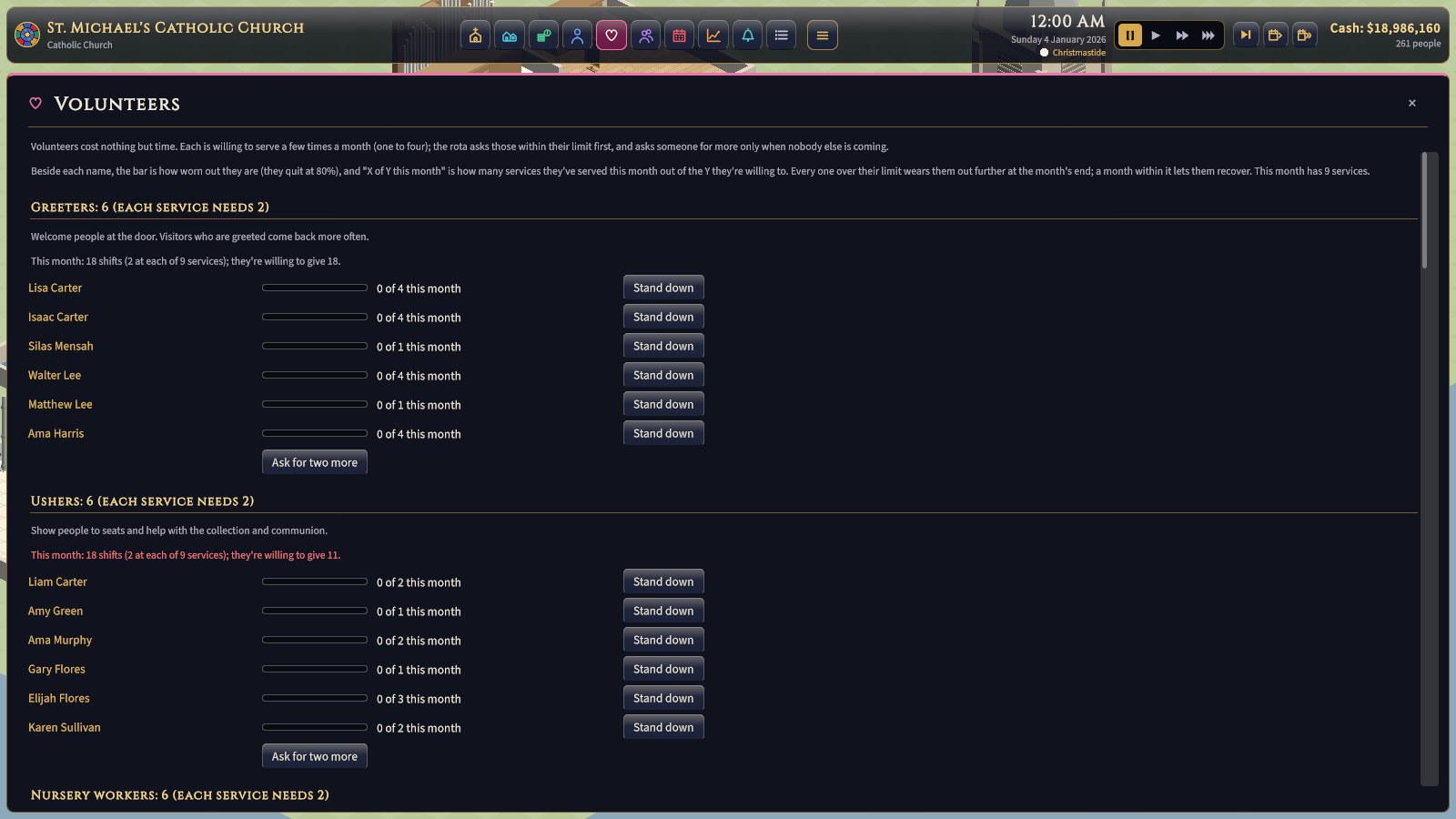
| Role | On duty | Effect |
|---|---|---|
| Greeter | 2 | Welcome people at the door. Up to +0.25 to the chance a visitor is welcomed (+0.15 instead of −0.1). |
| Usher | 2 | Show people to seats and help with the collection and communion. Visitors shown to a seat gain +0.03. |
| Nursery worker | 2 | Look after babies and toddlers during the service. The nursery only opens with someone on duty. |
| Choir | all of them | Sing every week they come. +0.04 for everyone with at least four singing (and +0.02 more from a choir loft). Eight are needed for the choir ministry. |
| Musician | up to 4 | Play the organ or piano for the hymns (one, unless a music director does), or all together in the band at a drum kit. |
| A/V tech | 1 | Needed on duty to live stream the service. |
| Sunday school teacher | 1 a classroom | A classroom only holds a Sunday school class with a teacher on duty. Teachers serve at Sunday school, not at services, and teach Vacation Bible School. |
| Group leader | 1 a group | Leads a small group through the week (Community → Ministries). |
| Acolyte, crucifer, lector, communion assistant | 1 or 2 | Worship's lay helpers, only in traditions that have them, by their names there (altar server, reader, deacon). A required one missing costs everyone at the service 0.03; one the tradition hopes for adds 0.02. Communion assistants serve only when there's communion. |
Lutherans need an acolyte, a lector, and two communion assistants at communion, and hope for a crucifer. Catholics and Episcopalians need altar servers and a lector; the Orthodox, altar servers and a reader. Presbyterian elders and Baptist deacons serve communion. Each helper's card on the Volunteers screen says what your tradition asks.
Recruiting
Ask for two more on the Volunteers screen asks the happiest adults in the church, who say yes with a chance equal to their satisfaction. You can also ask a particular person from their inspector (Ask: Greeter, Ask: Usher, and so on). Recruit when people are content.
The rota and burnout
- Each volunteer is willing to serve 1 to 4 services a month: one fewer where the tradition asks little commitment of its people, one more where it asks much, two more where it asks everything (the Witnesses), and more again for those in an auxiliary (see The church in its community). The rota asks those within their limit first, and asks someone for more only when nobody else is coming.
- Every service beyond their limit adds 0.25 burnout; a month within it takes 0.15 off.
- Burnout costs them up to 0.25 satisfaction a week, and at 0.8 they quit everything, usually unhappy enough to drift away.
- With services twice a week, each role needs twice the volunteers. The Volunteers screen shows each month's shifts against what your people will give.
- Ministry volunteers must be satisfied (0.5 or more), aged 16 to 80, and not already serving on Sunday. Fundraisers and door-to-door outreach tire those who run them too.
Recruit wide, not deep. Six greeters who each serve twice a month beat two who serve every week.
The rest cheat clears everyone's burnout, if you're experimenting (see Sandbox, cheats and quick reference).