Chapter 7
Worship and the church year
Sunday is the heart of the game: everything people feel is scored after a service. This chapter covers how each tradition worships, choosing the sermon, communion, the church year and its feasts, dressing the church for the season, and weddings and funerals.
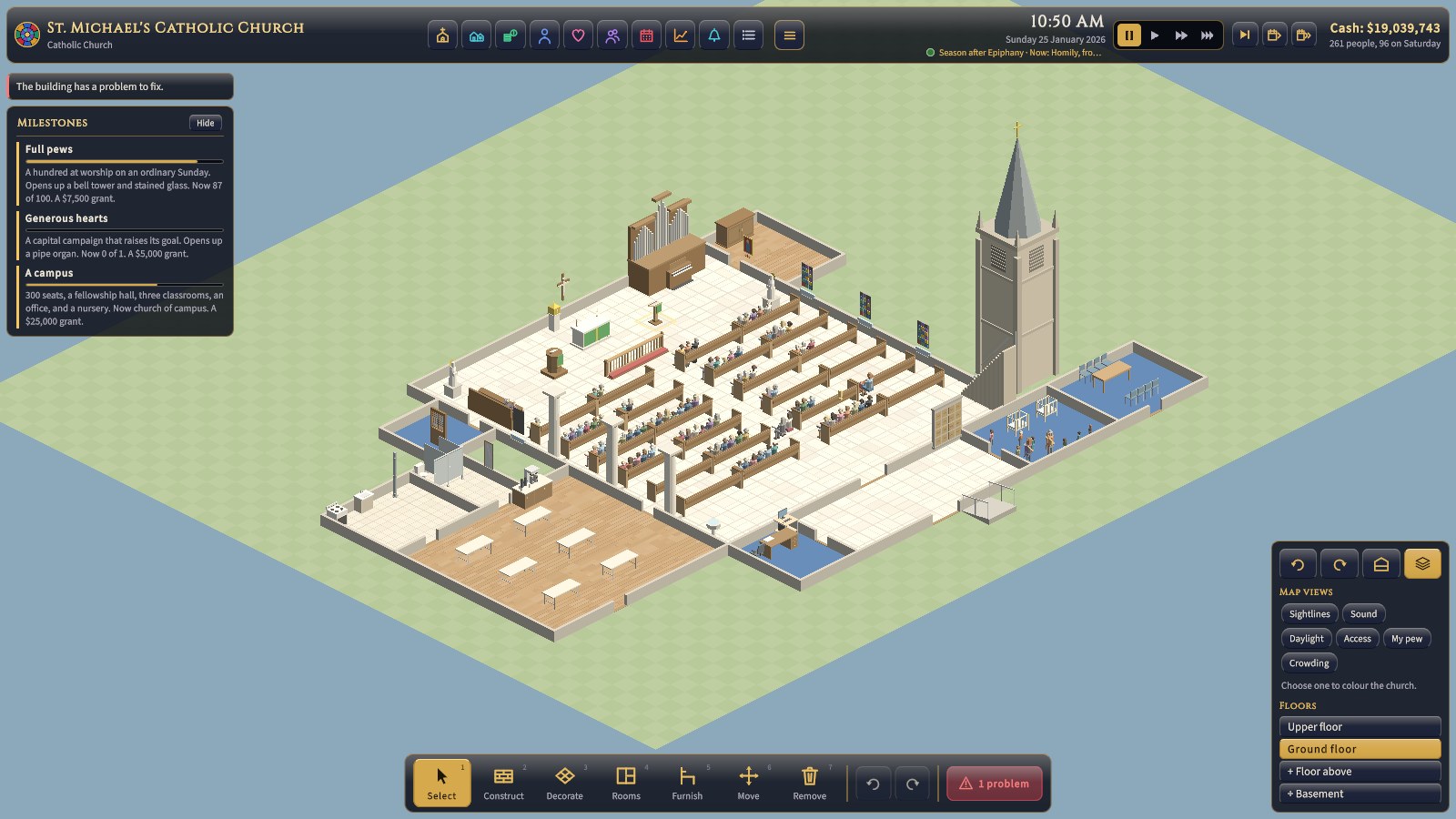
Services
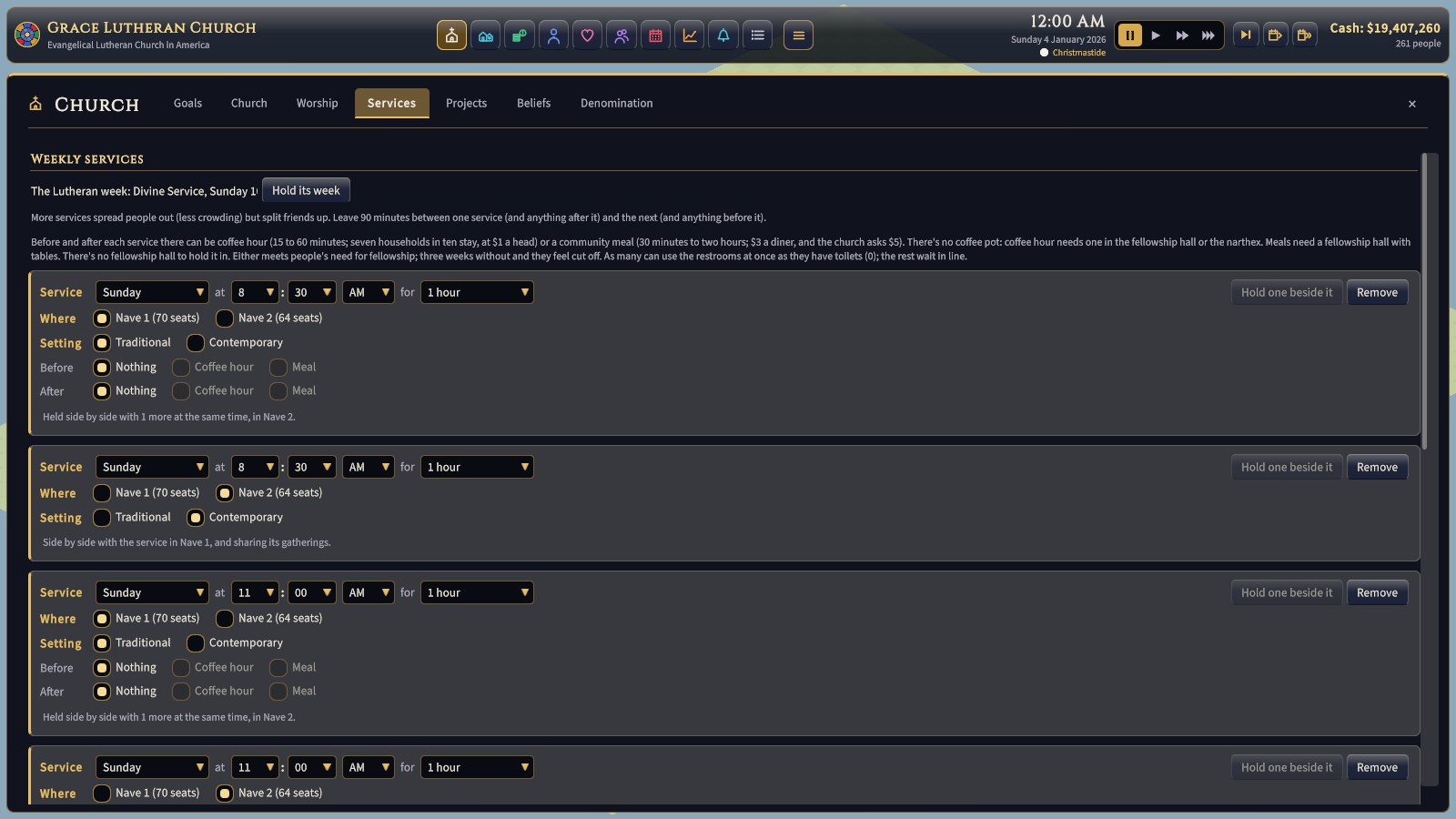
A church can hold up to four services a week, set in Church → Services. Each is a card: pick its day, its time (hour, minutes, AM or PM), and its length (60 minutes by default) from their lists, and Remove drops it. Each household keeps to one service. More services mean less crowding, but they split friends up and need more volunteers on duty. Leave 90 minutes between them.
During a service, the line under the clock names the part under way and where it's led from, and a glow marks that piece of furniture in the church.
Bulletins and the projection screen
A bulletin gives the order of service, the hymns, and the week's notices. The church prints one for each service, at $10 a service, unless it turns them off in Church → Services. A projection screen ($3,500, on a wall of the worship space) puts the words up instead: everyone can follow, heads up and hands free to sing (+0.02), and no bulletin is needed, though formal traditions find a screen out of place. With neither, visitors can't follow the service (−0.06) and regulars miss the notices (−0.02). An unprogrammed meeting has no order of service, so it prints nothing and misses nothing.
Service settings
Some traditions hold their services in a traditional setting (the organ, the choir, the hymnal) or a contemporary one (a band, songs, the words on screens): the ELCA, Missouri Synod, Methodists, Presbyterians, Catholics, Baptists, Nazarenes, and others. Each service's Setting chooses one; a contemporary service's music is played by the band at a drum kit. Younger people lean contemporary (three in four under 30), older ones traditional (nine in ten from 75). Hold one of each and every household goes to the one it prefers, and is glad of it (+0.02); hold just one and nothing changes.
Services side by side
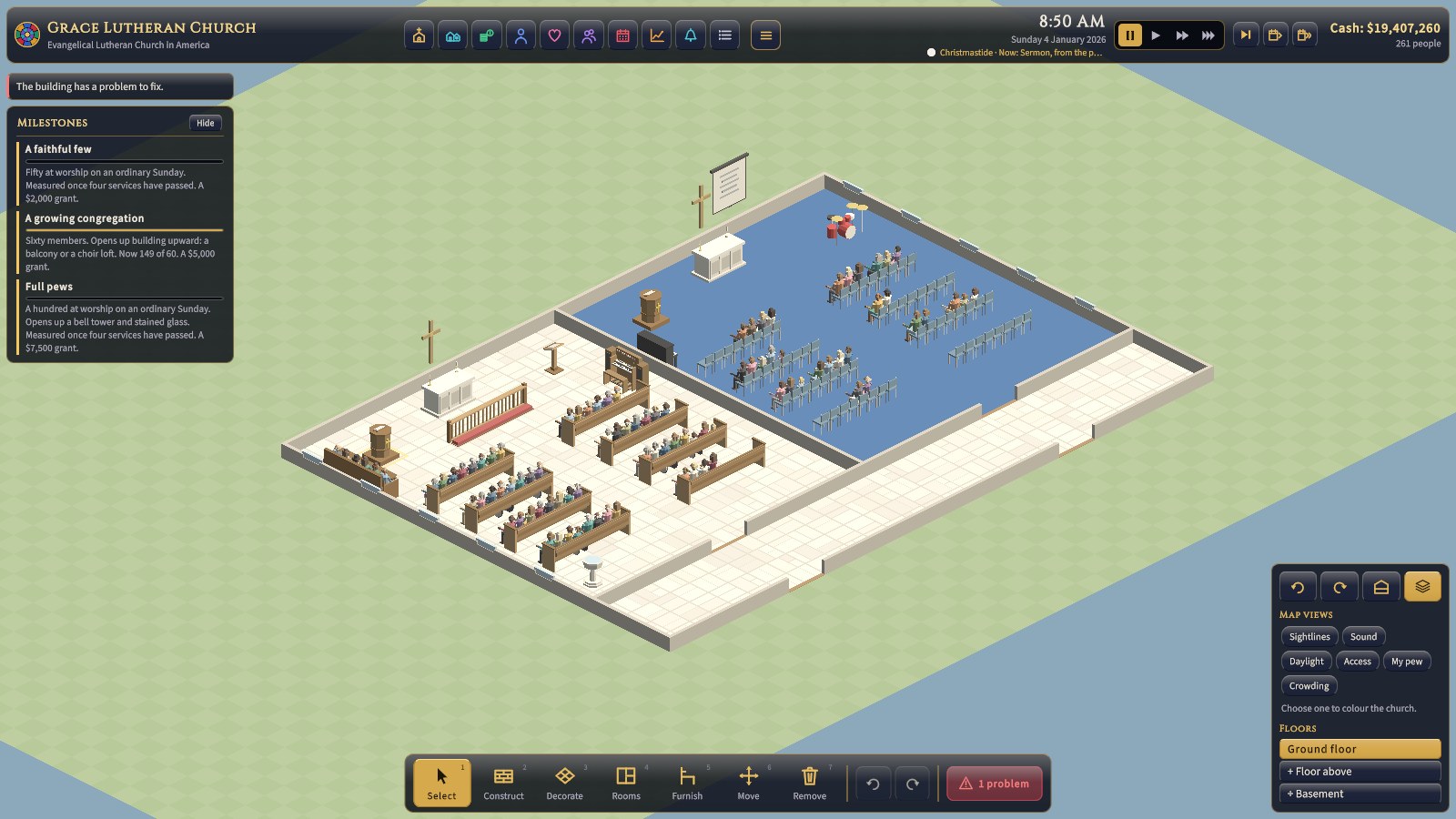
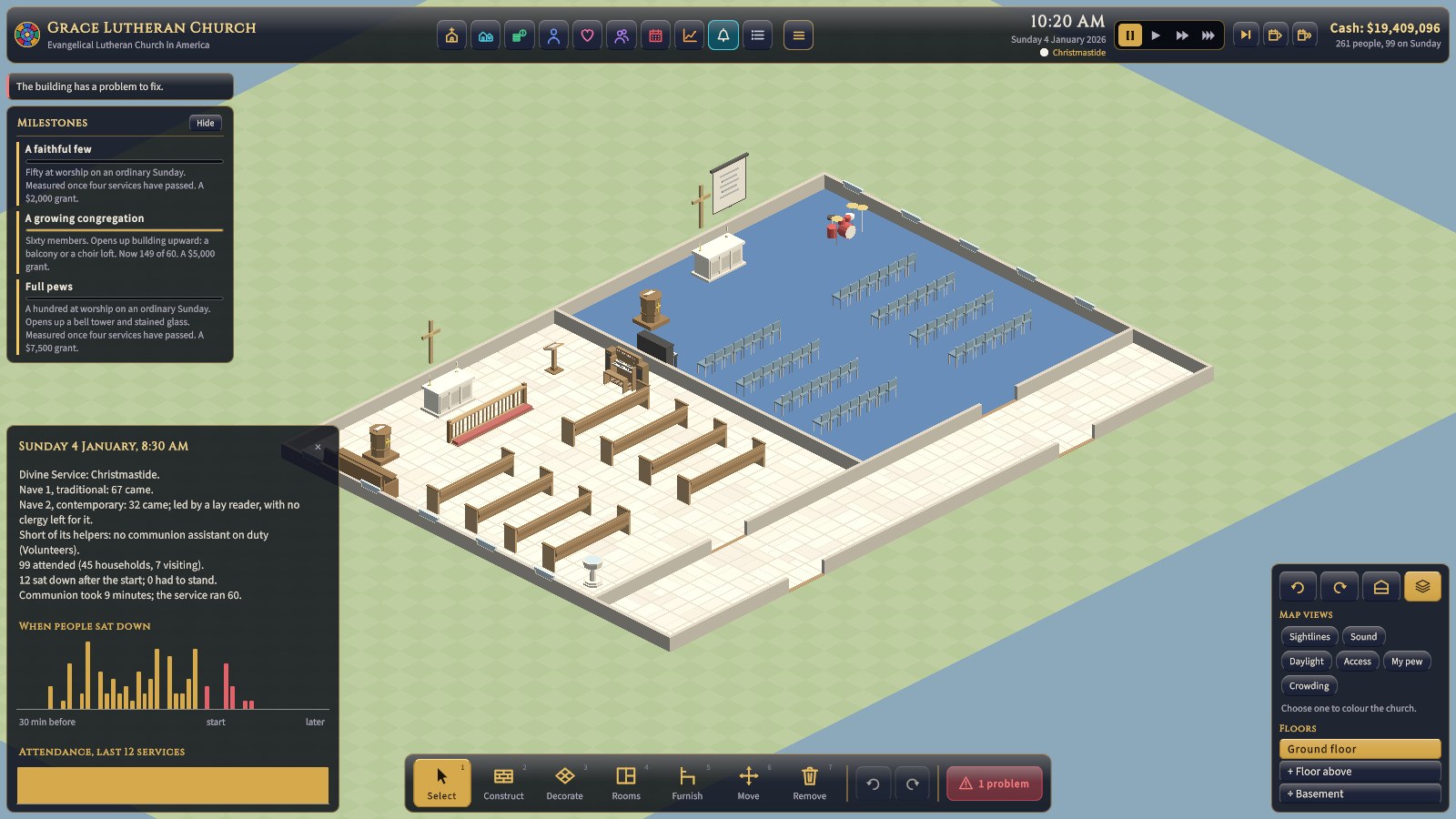
With two or more worship rooms, each service's Where chooses its room. Services at the same time in different rooms are held side by side: a traditional service in one nave and a contemporary one in the other, say, with each household at the one it prefers. Hold one beside it adds one. They last as long as each other and share the first one's coffee hour or meal. Each room has its own seats, music, communion, acoustics and daylight; each needs its own ushers, musicians and helpers, and costs what a service costs. A room with no clergy left to lead it has a lay reader (−0.04), so hire an associate. Every service after the week's first wears the building a little.
To hold them, build a second worship room (a second nave, off the same narthex, works well) with its own seats, an altar or table, and an instrument for its setting: a drum kit or piano for a contemporary service, an organ for a traditional one. Then, in Church → Services, set the first service's Where to one room and press Hold one beside it: the new service takes the other room, in the other setting. Change the first one's day or time and the one beside it moves with it. A church holding two pairs, at 8:30 and 11:00, with coffee hour between, holds four services a Sunday; up to eight a week can be scheduled.
Coffee hour and community meals
Each service can have a gathering before it and one after it, chosen on its card with the round option buttons (then its length, and how far from the service, from their lists): nothing, coffee hour (15 to 60 minutes, round a coffee pot in the fellowship hall or the narthex; seven households in ten stay, at 50 cents a head, as many as the pots make coffee for: 40 a pot, 200 a commercial one) or a community meal (30 minutes to two hours, in a fellowship hall with tables; three households in four stay). Each sits a gap from the service, in 15-minute steps: before, people come early, gather, and go in to their seats at its end, so leave a gap to find a seat; after, they go straight there. A meal's tables set how many eat: 16 at a folding table, 20 at a wooden one, and a household that won't fit is turned away (−0.03). Each diner costs $3 ($2 with a kitchen), and the church asks a $5 donation, which most adults give; everyone who eats is a little happier (+0.04). A second service needs 90 minutes clear of the first's gathering after and its own before. The service report gives how many had coffee, and how many wanted to eat and had a seat.
Sunday school
Sunday school meets once a week for 30, 45, or 60 minutes, at a day and time you set in Church → Services, in 15-minute steps. It can run right up to a service or its meals, but not into one. Households decide whether to come on their own, about half as readily as they come to worship. A classroom holds a class when it has seating and a Sunday school teacher (a volunteer) on duty, and takes as many as its seating holds; a household that can't all find seats is turned away. Those who went gain 0.04 at their next service, and those turned away lose 0.05. Someone at a service that runs into Sunday school goes straight there, and from Sunday school straight on to a service about to begin. Teaching materials cost $100 a year for each classroom with seating. After each session a note says how many came and how many had a seat.
Fellowship
Everyone needs time with the church beyond the service. Coffee hour, a community meal, Sunday school, or a small group meets it; anyone who goes three weeks without feels cut off (−0.03).
Weather
Each day has its weather, from the church's climate and the time of year. Rain and heat waves keep a few people home; snow keeps more, and a blizzard most, especially those who walk with difficulty or use a wheelchair. The service report names the weather, and the clock's note before a service says if it's snowing.
Baptism
In traditions that baptize, babies (where infants are baptized) and many who join wait to be baptized. At each service, everyone there who's waiting is baptized if the church has a font of its tradition's kind: a baptistry or an immersion font where it immerses. They gain 0.06, and everyone there 0.02. Without a font, the service report says how many are waiting.
The order of service
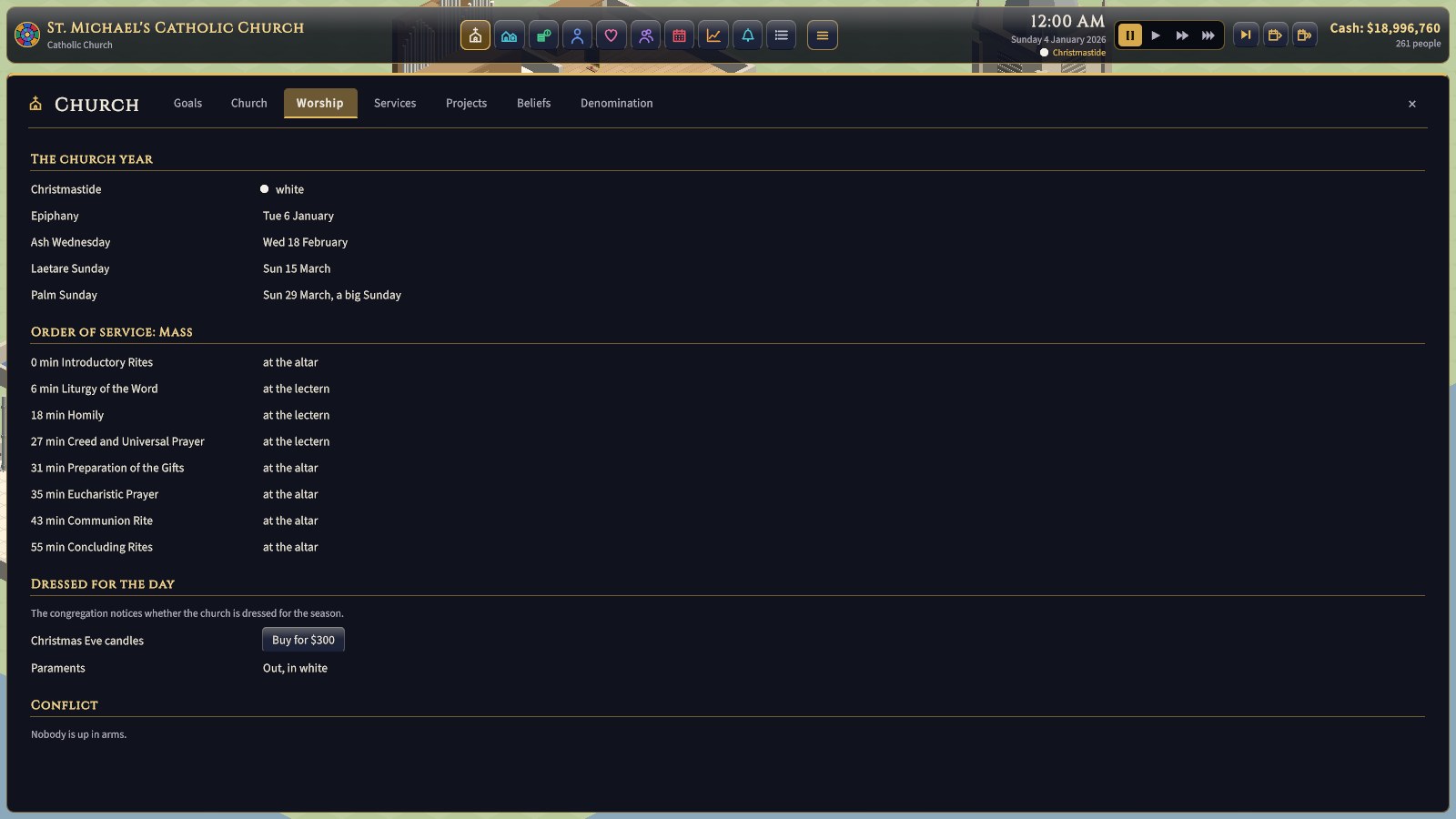
Each tradition has its own order of service. The church sets the service's length, and the parts are scaled to fit. Each part is led from the first of its listed items the church has, so a homily goes to the pulpit if there is one and the lectern if not. Church → Worship shows your church's order with its timings.
| Tradition | Service | Its parts (typical minutes) |
|---|---|---|
| Baptist | Preaching service | Welcome 3 · Congregational singing 12 (piano, organ, or drums) · Pastoral prayer 3 · Offering 4 · Scripture reading 3 · Sermon 25 · The Lord's Supper 7 (on communion Sundays) · Benediction 3 |
| Catholic | Mass | Introductory Rites 6 · Liturgy of the Word 12 · Homily 9 (lectern) · Creed and Universal Prayer 4 · Preparation of the Gifts 4 · Eucharistic Prayer 8 · Communion Rite 12 · Concluding Rites 5 |
| Lutheran | Divine Service | Gathering 8 · Readings and psalm 10 · Sermon 12 (pulpit) · Hymn of the day 4 (organ) · Creed and prayers 5 · Peace and offering 5 · Great Thanksgiving 5 · Communion 9 · Sending 2 |
| Pentecostal | Praise and worship | Welcome 2 · Praise and worship 25 (drums, sound system) · Prayer 3 · Tithes and offerings 5 · Sermon 30 · The Lord's Supper 5 · Altar call 10 |
| Orthodox | Divine Liturgy | Great Litany and antiphons 15 · Little Entrance 3 · Epistle and Gospel 8 · Homily 10 · Great Entrance 7 · Anaphora 15 · Holy Communion 10 · Dismissal and antidoron 7 |
| Calvary Chapel | Worship and teaching | Welcome 2 · Worship 25 (drums, sound system) · Prayer 3 · Teaching through the Word 45 · The Lord's Supper 6 (on communion Sundays) · Closing prayer 3. No offering in the service. |
| Christian Churches | Worship around the Lord's table | Welcome 2 · Songs of worship 15 · Prayer 3 · Scripture reading 3 · Communion meditation and prayers 3 · The Lord's Supper 8 · Offering 4 · Song 4 · Sermon 28 · The invitation 4 · Benediction 2 |
| Quaker | Meeting for worship | Settling into silence 2 · Waiting worship 25 · Vocal ministry 10 · Settled silence 20 · Close of worship 3. No pulpit, no sermon, no one appointed to lead. |
A tradition from a mod that names no service gets a generic one from its worship focus: a liturgy for sacrament-centred traditions, a preaching service for word-centred ones, an unprogrammed meeting for silent ones.
Communion
On the Sundays a tradition celebrates it (weekly for Catholics, Lutherans, and the Orthodox; monthly for Baptists and Pentecostals; never for Quakers), communion begins with its part of the service.
- Traditions that come forward to receive are served at an Altar, Communion table, Communion rail, or Communion station. Each serves one person per front tile at a time. A four-metre rail serves four at once; a one-metre station serves one.
- Baptists and Pentecostals pass the elements along the pews in Communion trays, which they expect to have.
- If communion takes too long, the service runs over, and everyone loses 0.05 for every 10 minutes over (up to 0.2). The service report says how long communion took. Add stations, or a longer rail.
Choosing the sermon
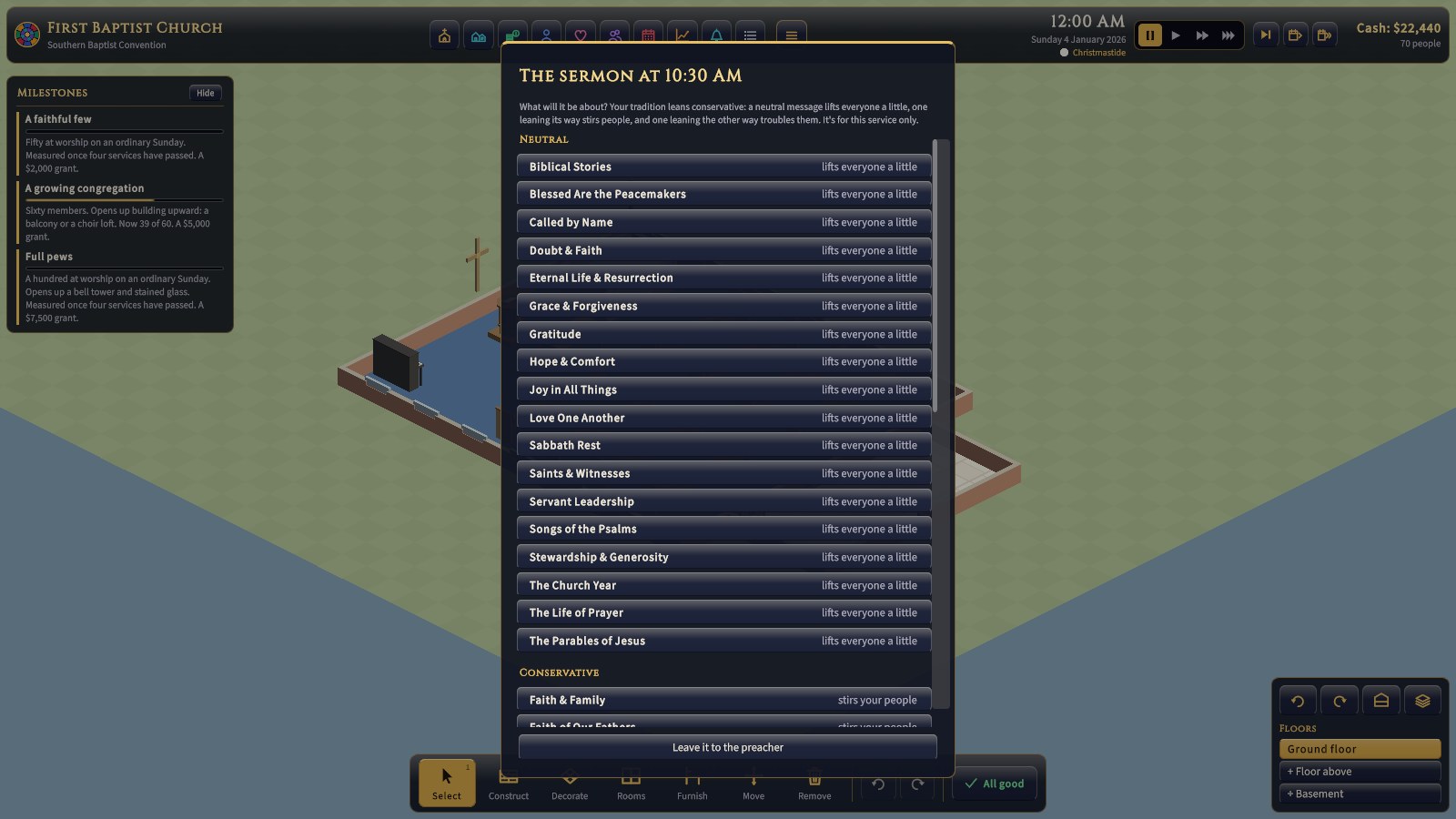
Half an hour before each service with a sermon or homily, the game pauses and asks what it will be about. The choice is for that service only. Leave it to the preacher (or Esc) means no particular message, which neither helps nor hurts.
Each topic's message leans neutral, conservative, or liberal, and each tradition's people lean one way too:
| Leaning | Traditions |
|---|---|
| Liberal | Lutheran (ELCA), Quaker |
| Neutral | Roman Catholic |
| Conservative | Baptist, Pentecostal, Eastern Orthodox |
After the service, everyone there (except those minding the nursery) feels the message, scaled by the topic's strength (1 for most, up to 2 for Fire & Brimstone):
| The message | Tradition leaning the same way | A neutral tradition | Tradition leaning the other way |
|---|---|---|---|
| Neutral | +0.015 | +0.015 | +0.015 |
| Leaning | +0.04 | −0.02 | −0.05 |
So Fire & Brimstone fires a conservative congregation up (+0.08), puts a neutral one off (−0.04), and troubles a liberal one deeply (−0.1). With no pastor, or no sermon in the service (a Quaker meeting), the topic counts for nothing. The game models how the message is received; it takes no side.
The safe default is any neutral topic: a small lift for everyone, every week. A topic leaning your tradition's way earns nearly three times as much, so it's worth picking one each week if you know your people. In a neutral (Catholic) parish, every leaning topic costs you. A sermon also travels on the live stream: members who watched at home are likelier to come in person next time if it suited them (see The church in its community).
All 42 sermon topics
| Topic | Leans | Strength | What it's about |
|---|---|---|---|
| Biblical Stories | Neutral | 1 | The great stories of scripture told and opened up: Abraham and Sarah, Ruth, the prodigal son, the road to Emmaus. |
| Blessed Are the Peacemakers | Neutral | 1 | Reconciliation close to home: in families, friendships, and the congregation itself. |
| Called by Name | Neutral | 1 | Belonging to God in baptism, and living as someone called. |
| Doubt & Faith | Neutral | 1 | Thomas, Job, and honest questions: faith that survives doubt. |
| Eternal Life & Resurrection | Neutral | 1 | The empty tomb, and the hope of life beyond death. |
| Grace & Forgiveness | Neutral | 1 | God's love freely given, and how to give it to one another. |
| Gratitude | Neutral | 1 | Counting blessings, and living thankfully. |
| Hope & Comfort | Neutral | 1 | Strength for hard days: grief, illness, and worry, and the promise that sustains through them. |
| Joy in All Things | Neutral | 1 | Paul's letter to the Philippians, written from prison: rejoicing whatever comes. |
| Love One Another | Neutral | 1 | The great commandment in daily life: at home, at work, and with those we find hard to love. |
| Sabbath Rest | Neutral | 1 | Rest as a gift and a commandment, for busy, tired people. |
| Saints & Witnesses | Neutral | 1 | The lives of the faithful who went before, and what they teach. |
| Servant Leadership | Neutral | 1 | Jesus washing the disciples' feet, and leading by serving. |
| Songs of the Psalms | Neutral | 1 | Praise, lament, and trust in Israel's songbook, and the prayers it gives words to. |
| Stewardship & Generosity | Neutral | 1 | Using time, talents, and money well, and giving gladly. |
| The Church Year | Neutral | 1 | What the season means, from the waiting of Advent to the fire of Pentecost. |
| The Life of Prayer | Neutral | 1 | Praying when it is easy and when it is hard: listening, persistence, and silence. |
| The Parables of Jesus | Neutral | 1 | The sower, the mustard seed, the lost sheep, the good Samaritan: what the stories Jesus told ask of us. |
| Faith & Family | Conservative | 1 | Marriage, parenthood, and handing on the faith: the family as the first church. |
| Faith of Our Fathers | Conservative | 1 | Holding fast to the faith and ways handed down, against the drift of the times. |
| Obedience & Discipline | Conservative | 1 | Duty, submission to God's order, and the discipline of a faithful life. |
| Personal Holiness | Conservative | 1 | Turning from sin to a disciplined, holy life: purity, sobriety, and self-control. |
| Resisting Temptation | Conservative | 1 | The pull of a worldly culture, and how to stand apart from it. |
| Spiritual Warfare | Conservative | 1 | The armour of God, and standing firm against the enemy. |
| The Authority of Scripture | Conservative | 1 | The Bible as the inerrant Word of God, and standing on it whatever the world says. |
| The Great Commission | Conservative | 1 | Go and make disciples: the urgency of every soul's salvation. |
| Marriage as God Designed | Conservative | 1.5 | Marriage as the covenant of one man and one woman, and keeping it holy. |
| Sanctity of Life | Conservative | 1.5 | Every life sacred, from conception to natural death. |
| The Last Days | Conservative | 1.5 | Prophecy, the return of Christ, and being ready when he comes. |
| Fire & Brimstone | Conservative | 2 | Sin, judgement, and the urgent call to repent before it is too late. |
| Care for Creation | Liberal | 1 | Tending the earth as God's gift: the climate, conservation, and simpler living. |
| Healing for All | Liberal | 1 | Health care, mental health, and building a society that cares for the sick. |
| Interfaith Understanding | Liberal | 1 | Learning from neighbours of other faiths, and what we hold in common. |
| Reading Scripture in Context | Liberal | 1 | The Bible read with history and criticism: what the texts meant then, and mean now. |
| Swords into Ploughshares | Liberal | 1 | Nonviolence and peace between nations, and the gospel against war. |
| The Prophets' Call | Liberal | 1 | Amos and Micah: let justice roll down like waters; do justice, love mercy. |
| Wealth & Poverty | Liberal | 1 | The rich young ruler and Mary's song: a challenge to wealth and to the systems that keep people poor. |
| Welcome the Stranger | Liberal | 1 | Hospitality to outsiders: refugees, immigrants, and anyone on the margins. |
| Women Who Led | Liberal | 1 | Deborah, Mary Magdalene, Phoebe, and Junia: women leading God's people, then and now. |
| Racial Justice & Reconciliation | Liberal | 1.5 | Racism as sin, and the church's work of repair and reconciliation. |
| Radical Inclusion | Liberal | 1.5 | A table with room for everyone, LGBTQ people fully included in the life of the church. |
| Social Justice Call | Liberal | 1.5 | A call to act for the poor and the oppressed: fair wages, decent housing, and the dignity of every person. |
The church year
Every tradition except the Quakers keeps a church year. Western churches (Baptist, Catholic, Lutheran, Pentecostal) use the Western calendar; the Orthodox use the Eastern, with Pascha by the Julian reckoning (never earlier than Western Easter). The line under the clock shows the season and its liturgical colour.
| Western seasons | Colour | Eastern seasons | Colour |
|---|---|---|---|
| Advent | violet | Nativity Fast | red |
| Christmastide | white | Nativity and Theophany | white |
| Season after Epiphany | green | Before Great Lent | gold |
| Lent | violet | Great Lent | violet |
| Holy Week | red | Holy Week | black |
| Eastertide | white | Paschal season | red |
| Ordinary Time | green | After Pentecost | gold |
Big Sundays
Some feasts make regulars more likely to come to a service near them, and newcomers feel it twice as much:
| Feast | Effect |
|---|---|
| Christmas, Easter Day (Western) | Regulars twice as likely to come (up to 98%); three times the usual newcomers. |
| Pascha (Eastern) | Even stronger than Western Easter. |
| Nativity of Christ (Eastern) | Nearly as strong as Christmas. |
| Palm Sunday, Theophany, Entry into Jerusalem | A little busier than usual. |
| Pentecost | Slightly busier. |
Special services
Some days have one service for everyone, not just one service's share. Church → Services lists those your tradition keeps, with the next date of each; untick Hold it on any your church doesn't hold. Each has communion as your tradition would on that day (every one, where communion is weekly) until you set its Communion toggle, on or off; the church's own special services have it too.
| Service | When | Who keeps it | Crowd |
|---|---|---|---|
| Christmas Eve | 24 December, 5 pm | Traditions with a church year | Nearly everyone, and four times the newcomers |
| Ash Wednesday | 46 days before Easter, 7 pm | Western liturgical traditions | The faithful: under half a Sunday |
| Good Friday | The Friday before Easter, 7 pm | Traditions with a church year | Under half a Sunday |
| Easter sunrise | Easter morning, 6:30, before the usual services | Traditions with a church year | Half a Sunday |
| Thanksgiving eve | The Wednesday before Thanksgiving, 7 pm | Every tradition | Half a Sunday |
Church → Services can add the church's own special services too, in a dialog: Add a special service, or Change on one already there. Give it a name, and say how it comes round: one day or yearly on a date (picked from a calendar), so many days from Easter (Ascension is 39 days after; your tradition's own Easter, so Orthodox churches follow Pascha) or from Christmas (Epiphany is 12 days after), or a weekday of a month (the third Sunday of October, the last Friday of November). Then when it starts, how long it lasts (− and +), and whether it draws fewer than a Sunday, as many, or more. The dialog says when the next one falls, and nothing changes until you save it. The smaller special services (all but Christmas Eve) are felt half as much as a Sunday.
On Christmas Eve, people are two and a half times as likely to come (up to 98%), and four times the usual newcomers come with them. A church sized for an ordinary Sunday overflows and people stand. It's your best recruiting night of the year if you have the seats and the greeters: consider extra chairs, and every greeter and usher on duty.
Dressed for the day
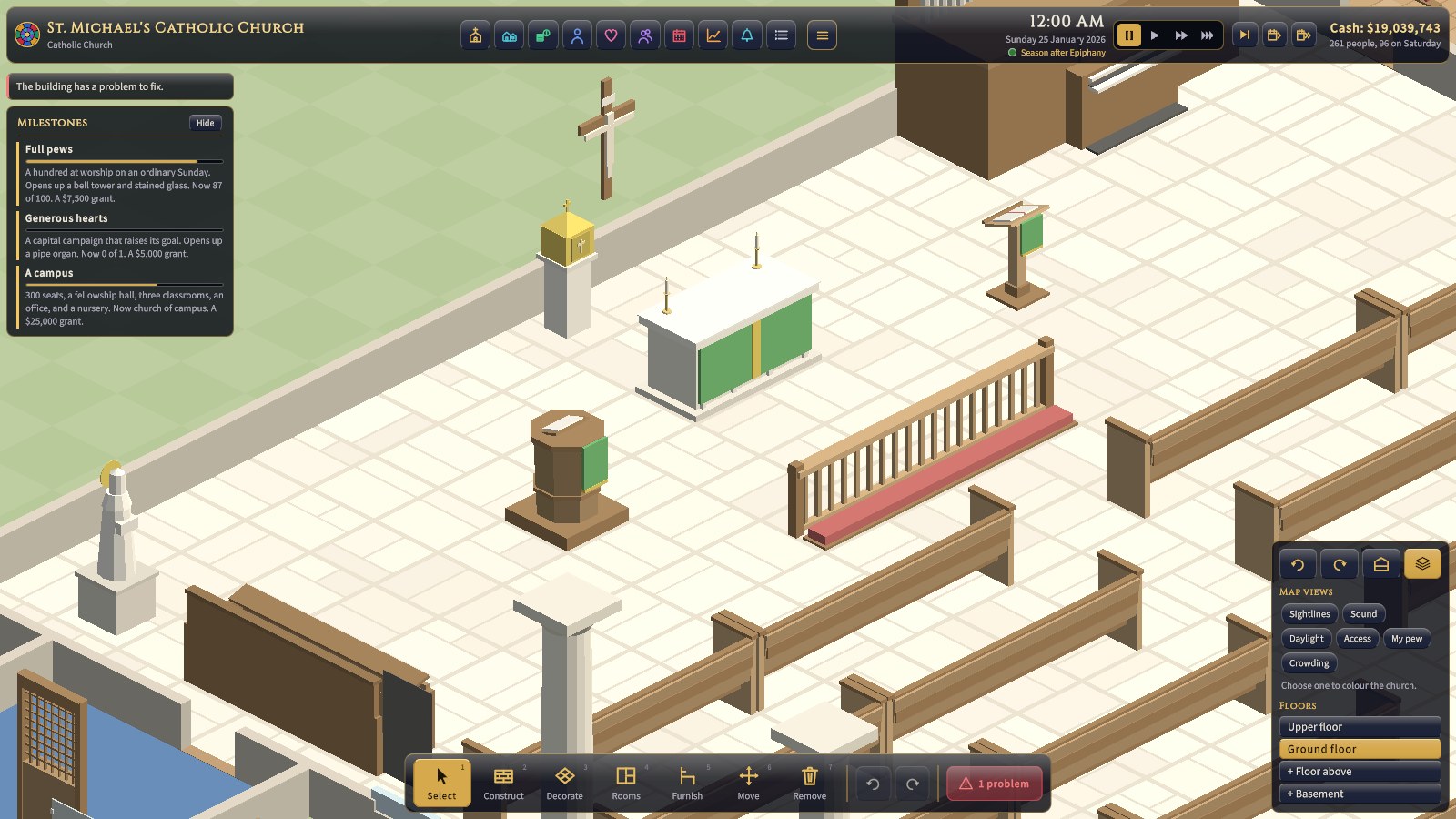
Traditions with a church year notice whether the church is dressed for the season. After each service they compare the decor the day calls for with what the church owns, placed or in the cupboard: from −0.04 with none to +0.04 with all, scaled by the tradition's formality (in full for high-church traditions, a third for low).
| Item | Price | Out |
|---|---|---|
| Paraments | $2,400 | Always, in the colour of the day, on the altar, table, pulpit, and lectern |
| Advent wreath | $250 | Advent |
| Christmas Eve candles | $300 | Christmas through Christmastide |
| Easter lilies | $400 | Easter Day through the Easter season |
Church → Worship lists the decor the season calls for, with a Buy button for anything you're missing. All four together cost $3,350: an easy, permanent lift for any high-church parish.
Weddings and funerals
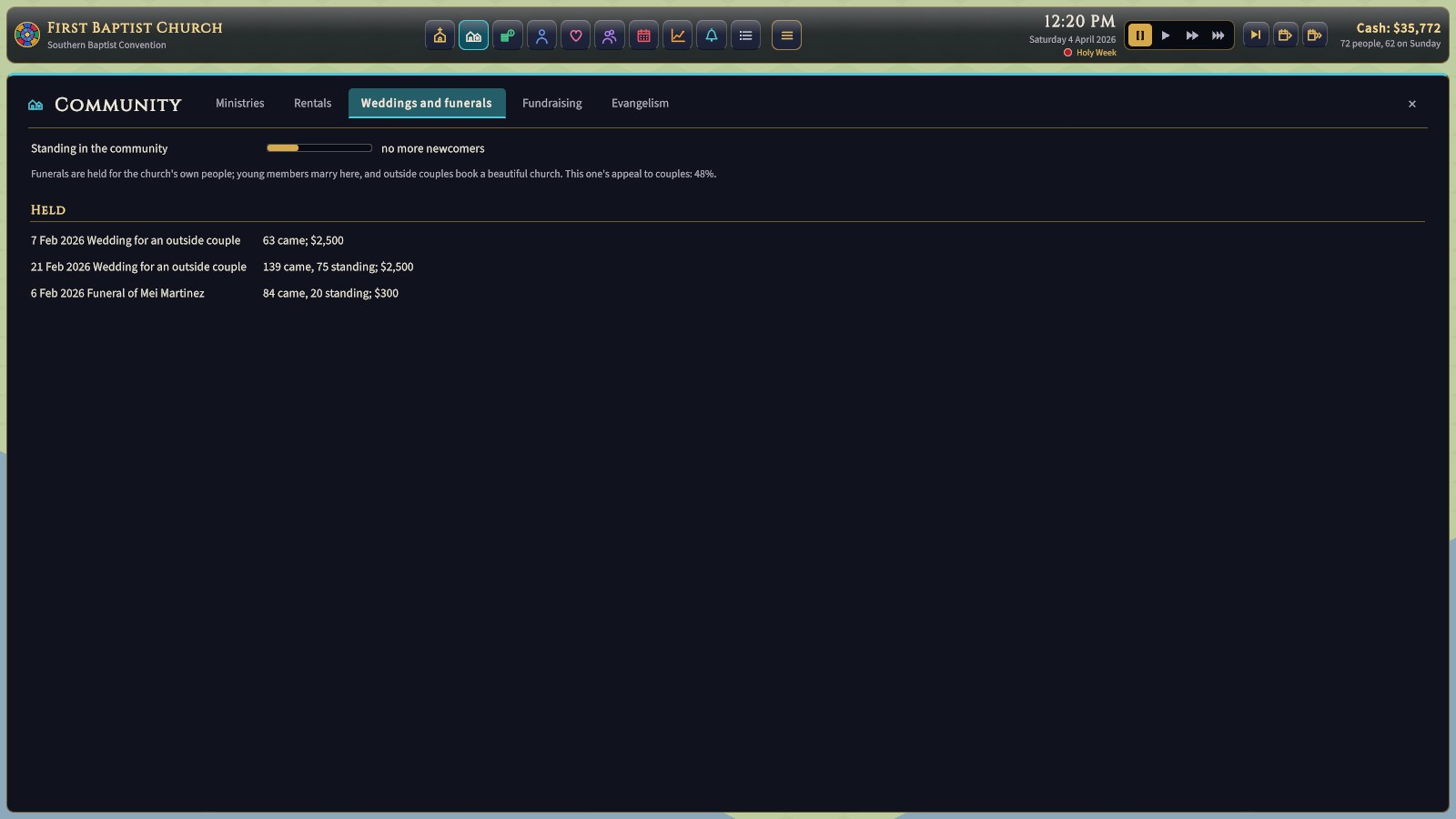
- Funerals. When one of the church's people dies, the funeral is held there five days later, on a weekday morning. About 25 come, plus a share of the congregation that grows with how long the person had come (15%, and 3% more a year, up to 80%). The church receives $300, and the family feel cared for (+0.05).
- Weddings of your own. Young adults (22 to 34) in the church marry at about 5% a year. Each wedding is on a Saturday afternoon and earns $400.
- Outside weddings. Couples from outside book a beautiful church, up to one a month for the grandest, for $2,500. How much they want yours depends half on the style's formality and half on the average looks of what stands in the worship space. A Gothic nave full of handsome furniture is a steady income.